
Why PSLE Cut-Off Points Cause Confusion: What Parents Need to Know
Every November, thousands of parents look for the latest Singapore secondary school cut-off points to navigate the new PSLE AL score system. The anxiety is real, but the information available is often contradictory. Understanding how AL scores and cut-off points actually work is critical.
The common misunderstanding
A “good” PSLE score doesn’t guarantee entry into a specific school. A student with AL 6 might not gain entry to their target school, while another with AL 8–9 might be happily admitted elsewhere. Why? Because cut-off points are dynamic benchmarks determined by hundreds of students competing for limited places in that particular year and school.
Why outdated lists lead to poor choices
Many parents find lists from 2021 and treat them as current. Cut-offs shift yearly because of demand, cohort strength, and programme popularity. A school that required AL 4 last year might need AL 5 this year if 500 more students applied. The real damage is making school choices based on incomplete information, leading to disappointment or poor fit.
Understanding How PSLE AL Scores and Secondary School Cut-Off Points Work
What is a PSLE AL score?
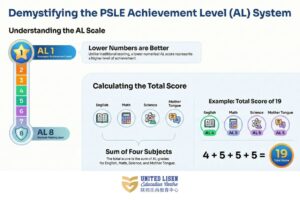
PSLE results are reported in Achievement Levels (AL), not percentages or raw scores. AL 1 is strongest, AL 8 is the weakest passing level. Most importantly: Lower numbers are better. This inverted logic confuses many parents. Your PSLE score is four separate AL grades (English, Math, Science, Mother Tongue) combined into a total. A student with AL 4, 5, 5, 5 has a total PSLE score of 19.
What does a secondary school cut-off point (COP) mean?
A school’s COP represents the weakest score admitted in that year’s posting round. It tells you what happened last year, not what will happen this year or whether you’ll be posted.
Critical: COPs are results, not rules. Tie-breakers determine outcomes when scores match.
Factors that influence yearly cut-off changes
- Demand: Popular new programmes surge applications.
- Cohort strength: Stronger years shift cut-offs upward.
- Affiliations: DSA status, affiliated primary school graduates, or new facilities spike applications.
These variables make cut-off points dynamic, not fixed.
What Is Full Subject-Based Banding (FSBB)?
Since 2024, Singapore has transitioned entirely to Full Subject-Based Banding. This marks the biggest change to secondary school entry in 40 years, yet many parents still operate under the old system.
From Express/Normal streams to Posting Groups
The shift:
OLD SYSTEM (Pre-2024) NEW SYSTEM (2024 onwards)
──────────────────────── ─────────────────────────
Express Stream →→→→→ Posting Group 3 (PG3)
Normal Academic →→→→→ Posting Group 2 (PG2)
Normal Technical →→→→→ Posting Group 1 (PG1)
Students are now posted to secondary schools based on their PSLE AL scores across their entire profile, then assigned to one of three posting groups:
- Posting Group 3 (PG3): Roughly equivalent to the old Express stream. Students predominantly take subjects at G3 (General 3) level.
- Posting Group 2 (PG2): Roughly equivalent to the old Normal Academic stream. Students predominantly take subjects at G2 (General 2) level.
- Posting Group 1 (PG1): Roughly equivalent to the old Normal Technical stream. Students predominantly take subjects at G1 (General 1) level.
Mixed form classes: A crucial shift
Here’s what changed that affects daily school life: There are no longer separate Express, Normal, or Technical classes. Instead, students are placed in mixed form classes with peers from all three posting groups. This means your child will study alongside students with different strengths, interests, and learning paths. Teachers scaffold instruction to support this mixed-ability environment. For many students, this creates a more inclusive, less pressurised atmosphere. This structural change is critical to understand because it directly affects school culture and the social experience of secondary school.
Reading and Using Cut-Off Point Lists Effectively

Posting Groups and score interpretation
When comparing schools, always compare the same posting group to the same posting group: PG3 to PG3, PG2 to PG2, PG1 to PG1. For example, a school’s PG3 cut-off might be AL 8, while its PG2 cut-off is AL 15–18. This doesn’t mean PG2 is “easier”, it means there’s less competition for PG2 places because fewer students apply to that posting group at that school.
Why comparing schools only by cut-off score is misleading
Two schools with the same COP might have very different cultures, support systems, and fit for your child. Choosing by COP alone ignores the environment, which is critical for success.
Understanding score ranges instead of exact numbers
Think in categories:
- Safe (score 2–3 levels better than COP).
- Realistic (matching COP).
- Stretch (1–2 levels above COP).
2025/2026 AL Score Ranges for Singapore Secondary Schools
Understanding COP vs PSLE Score Range
When you see data about secondary schools, two numbers matter:
- PSLE Score Range: The first and last student admitted (e.g., “5 to 8” means the best admitted student scored AL 5, the weakest admitted scored AL 8)
- Cut-Off Point (COP): The score of the last student admitted (e.g., COP = 8)
If a school’s COP is shown as 6(D), a student with AL 6 but Merit in Higher Chinese may rank behind those with AL 6 but Distinction during tie-breakers.
The table below shows Cut-Off Points (COP) for top Singapore secondary schools based on 2025 PSLE posting results. These are single-value cutoffs, not ranges.
| School Name | Type | IP | COP (PG3) | Notes |
| Raffles Institution | IP | 6 | – | Top boys’ IP school |
| Raffles Girls’ School | IP | 6 | – | Top girls’ IP school |
| Nanyang Girls’ High School* | IP, SAP | 6M | – | SAP school; HCL required |
| Hwa Chong Institution* | IP, SAP | 6M | – | Strong STEM and bilingual |
| CHIJ St. Nicholas Girls’ | IP, SAP | 7M | 8M | SAP school; HCL required |
| Catholic High School* | SAP | 7M | 8M | SAP school; HCL required |
| Dunman High School* | IP, SAP | 8M | – | Known for supportive culture |
Important reminders:
- COP is not a guarantee. Even if your score meets the COP, tie-breakers (citizenship, choice order, balloting) determine final posting.
- Affiliation advantage: Students from affiliated primary schools often have a less stringent COP than non-affiliated applicants. For example, an affiliated student might get into a school with AL 12, while non-affiliated students need AL 10.
- Your child’s actual posting depends on: (1) posting group, (2) school demand that year, (3) affiliation status, (4) choice order, and (5) citizenship.
- Always cross-check with MOE SchoolFinder for the most current data before submitting your final choices.
Common Mistakes When Using Cut-Off Lists to Choose Schools

Treating cut-off points as guarantees
- The mistake: “My child scored AL 8; the COP is AL 10, so they probably won’t get in. My child scored AL 9; the COP is AL 10, so they will.”
- The reality: COP is historical data, not a prediction. Tie-breakers determine outcomes when scores match. Even meeting the COP doesn’t guarantee admission.
Ignoring student learning style and environment fit
A brilliant student in a poor-fit school can underperform. A student with a lower PSLE score in the right environment may thrive. Choosing by COP alone ignores culture, support, and social environment,all critical for success.
Over-prioritising prestige over sustainability
A child at a prestigious school they hate suffers real damage. The best school challenges appropriately, supports structurally, and engages emotionally, not necessarily the highest-ranked one.
The Critical Role of Tie-Breakers: Why Meeting COP Isn’t a Guarantee
One of the biggest misconceptions parents have is that meeting the COP guarantees admission. This is false. When multiple students have the same score, MOE applies tie-breakers to determine who gets posted.
Tie-breaker order (in sequence)
When multiple students compete for the same spot with the same COP, MOE applies tie-breakers in this order:
COMPETING STUDENTS WITH SAME SCORE
↓
Step 1: Check Citizenship
↓ (Singapore Citizens prioritized)
Step 2: Check Choice Order
↓ (1st choice > 2nd choice > etc.)
Step 3: Random Balloting
↓ (50/50 lottery if still tied)
FINAL POSTING DECISION
- Step 1: Citizenship , Singapore Citizens > Permanent Residents > International Students
- Step 2: Choice Order , If citizenship is tied, the student who ranked the school as 1st choice beats 2nd choice, which beats 3rd choice, etc.
- Step 3: Balloting , If still tied, random selection.
Why choice order matters most (as a tie-breaker)
Critical clarification: Choice order does NOT allow a lower-scoring student to “jump” a higher-scoring student. It is a tie-breaker only when two students have the same AL score and citizenship.
When it applies: If two students both have AL 10 and are Singapore Citizens competing for the last spot at the same school, the one who ranked the school as their 1st choice gets priority over the one who ranked it as their 4th choice.
Why this matters for your strategy: When building your six-choice submission, place schools strategically. Choice Order matters only in close calls, so rank schools by true preference, not by perceived safety or difficulty.
Building Your Secondary School Shortlist: A Practical Guide

Step-by-step approach to building a realistic school shortlist
Step 1: Confirm your Posting Group (MOE assigns this based on your PSLE AL score; if you score on a boundary, you choose).
Step 2: Calculate your realistic range. If you score AL 12 for PG3, target schools with COPs around AL 14–16 (safe), AL 12–13 (realistic), and AL 10–11 (stretch).
Step 3: Research each school beyond cut-off scores. Visit websites, attend open houses, check CCAs, and assess pastoral support.
Step 4: For each school, verify:
- Posting Group and academic fit
- CCAs your child genuinely wants
- Realistic commute (under 45 minutes)
- School culture matches your child’s temperament
- Mixed form classes,your child is comfortable with mixed-ability peers
Step 5: Build a balanced six-choice submission: 2–3 realistic options, 1–2 stretch, 1 safe choice. Choose the school as your first choice only if it’s a realistic or safe option,don’t waste your top choice on a stretch school.
The above guidance is provided for general informational purposes only and does not constitute placement advice. Each child’s academic profile, readiness, and personal circumstances vary. Parents are strongly encouraged to consider the child’s actual performance and suitability and to exercise their own judgment when determining school preferences.
Questions students and parents should ask before final selection
- Does my child feel excited about (or at least comfortable with) this school?
- Can they sustain the commute and workload healthily?
- Are there activities, subjects, or programmes they genuinely care about?
- Will the school’s mixed form class culture support their growth?
- Have we visited in person, not just browsed online?
When and how to seek additional guidance
Educational counsellors can provide one-on-one support in understanding your child’s learning profile and matching it to schools,moving beyond cut-off scores to find real fit. Organisations like United Lisen offer neutral, research-based guidance on secondary school selection aligned with your child’s individual needs and the Full SBB system. Professional guidance is particularly valuable if your child has learning differences, extreme commute constraints, or if you’re struggling to make a decision between schools.
Conclusion
Key takeaways for interpreting PSLE scores and cut-off points
Cut-off points are indicators, not guarantees. The COP tells you where last year’s competition landed, not where it will land this year or if tie-breakers will affect your child. The AL score ranges provided above are reference points for research, not definitive predictions.
How informed understanding leads to better school choices
When you understand Full SBB’s mixed form classes, the role of tie-breakers, and the difference between COP and PSLE score range, you make more confident choices. You build a balanced shortlist. You ask the right questions. You choose based on evidence and fit,not fear or prestige.
Final reminder
The secondary school you choose matters, but it’s not your child’s only opportunity. Thousands thrive in schools with higher COPs, thousands excel in schools with lower ones. The difference isn’t the school’s ranking, it’s the match between the student and the environment. Choose with eyes open, your child’s learning profile in mind, and confidence that many good schools exist. Your job is finding the right one for your child.