

Feeling overwhelmed by the PSLE scoring system? Take a deep breath. You’re not alone in this.

Thousands of Singaporean families face substantial difficulties in the Primary School Leaving Examination, which determines their child’s educational advancement through academic assessments each year. The good news? Educational institutions have implemented various reforms to create an equal, stress-free PSLE scoring system that maximises transparency. Since 2021, the Achievement Level (AL) scoring system has become the standard to evaluate primary school graduation performance, while the former competition-heavy T-score system no longer exists.

A new PSLE scoring system implemented changes to education standards for children. This adjustment brings substantial meaning to each student’s academic development. What steps do schools utilise to compute new PSLE scores through the Achievement Level scoring system? Parents must pay particular attention to these educational developments for what reason? This guide delivers a detailed breakdown of essential PSLE knowledge, free of difficult terminology and with useful information to help you understand Singapore’s highly discussed academic milestone.
What Is the PSLE and Why Does the PSLE Scoring System Matter?
PSLE is more than an ordinary school assessment because every government primary school student in Singapore must participate during their final year of primary education. PSLE acts as a fundamental element which grants access to specific secondary schools and directs academic progression to the next educational level.

The PSLE scoring system fulfils three vital objectives.
-
Placement Power
- PSLE results play a key role in determining what type of secondary school the students will join after completing Primary 6 at the end of their studies.
- The obtained score serves as the basis to establish which educational institutions match a student’s qualification criteria.
-
Pathway Determination
- A new educational system named Full Subject-Based Banding (Full SBB) provides students with better freedom to choose their subjects.
- Schools now allow students to choose different educational levels according to their intellectual abilities.

-
Future Preparation
- Schools with various specialised programming accept students who achieve remarkable scores in the PSLE.
- Although PSLE marks are important, they must be viewed as one factor among many that determine future achievement.
- Students can learn at their speed because the educational system provides better adaptability regarding learning speeds and methods.


The bottom line? The knowledge of the PSLE Scoring System enables parents to make wise decisions regarding their child’s school selection and personalised learning support throughout their elementary years.
From T-Score to AL System: Understanding the Major Changes
The T-score evaluation, the previous PSLE scoring system, produced an enormously competitive atmosphere before 2021. Here’s why it became problematic:
- Students received evaluations based on how well they performed in comparison with other students instead of being assessed on their individual knowledge level.
- Students were placed in different ranking positions because of the slimmest mark differences.
- Inappropriate competition among young children emerged as a direct result of the system.
- The comparison of small score differences created extreme parental distress that led to unnecessary anxiety.
The New AL System: A More Balanced Approach
To address previous shortcomings, the Ministry of Education (MOE) developed the Achievement Level (AL) system, which delivered multiple constructive changes.
- Smaller stress levels result from removing small score variations at the micro-scale
- The new assessment method measures students through standard criteria instead of peer comparison.
- The new PSLE scoring system uses AL1 to AL8 bands for each subject as standardised rating categories instead of complex aggregation methods.
Correct learning should be the core objective of education instead of constantly competing between students. Through the AL system, students can focus on gaining conceptual understanding, but they no longer feel pressure to outperform others.
Breaking Down the AL (Achievement Level) System
What are AL Scores?
Each of the subjects within the revamped PSLE Scoring System earns Achievement Levels, starting from AL1, which represents the highest, to AL8, which represents the lowest tier. Here’s the complete breakdown:
| Achievement Level | Raw Mark Range |
| AL1 | 90–100 |
| AL2 | 85-89 |
| AL3 | 80-84 |
| AL4 | 75-79 |
| AL5 | 65-74 |
| AL6 | 45-64 |
| AL7 | 20-44 |
| AL8 | Below 20 |
Key things to note:
- The system uses AL1 as the top score, followed by AL8 as the lowest score, where lower values demonstrate superior achievement.
- PSLE bands offer reduced scope at the upper levels (AL1 to AL4) to differentiate the highest achievers.
- Excessive differentiation diminishes as bands stretch from the middle and lower levels to up to 20 marks for AL6.
PSLE Subjects and Their AL Bands
The four fundamental subjects, English alongside Mother Tongue Language, Mathematics, and Science, operate within the identical system of AL bands.
Example Scenario:
The 88 score in science positions a student within the AL2 band because it lies between 85 and 89.
A student who earns 88 marks in Mathematics will also receive an AL2 label under this PSLE scoring system.
In the new PSLE scoring system, higher mother tongue is graded separately as distinction, merit, and pass because it doesn’t affect the final PSLE score
How the PSLE Score Is Calculated: A Step-by-Step Explanation
Your child receiving a PSLE Score requires the addition of ALs from their four subject assessments. A detailed illustration shows how the PSLE scoring system works.
Sample Calculation:
- English: Raw score 82 -falls in the 80-84 range → AL3
- Mother Tongue: Raw score 74 – falls in the 65-74 range → AL5
- Mathematics: Raw score 91 – falls in the 90-100 range → AL1
- Science: Raw score 88 – falls in the 85-89 range → AL2
The total PSLE score of AL3 + AL5 + AL1 + AL2 equals 11.
In the new PSLE scoring system, students who obtain AL1 marks in all four subjects will achieve the best score possible, which amounts to a total of 4. The worst possible result is 32, where the students get A8 in all subjects. A maximum of 29 scores (starting from 4 and reaching 32) represents the entire range of possible results in the PSLE scoring system.
What Your Child’s PSLE Score Means for Secondary School Placement
School Posting Groups
All secondary schools now operate with Posting Groups instead of the former streaming approach since 2024.
| PSLE Score | Posting Groups | Indicative Level for Most Subjects at Start of S1 |
| 4 – 20 | 3 | G3 |
| 21 and 22 | 2 or 3 | G2 or G3 |
| 23 and 24 | 2 | G2 |
| 25 | 1 or 2 | G1 or G2 |
| 26 – 30 (with AL7 or better in English and Math) | 1 | G1 |
How the School Selection Process Works
Parents can submit up to 6 school preferences to the authorities after their children receive PSLE results, 1st choice being the most preferred. Here are some things to note when selecting a school:
- The PSLE score serves as the main evaluation criterion through which they give priority to students with lower scores.
- School placements start with Singapore citizens before accepting PR status students and continue to international students.
- In case of ties among applicants based on their priority choices, schools at the top of their lists receive higher priority.
The correct strategy during school application consists of accurate ordering of preferred schools independently from anticipated posting probabilities. The order in which applicants select their preferred schools plays a crucial role in deciding admissions when two candidates are tied.
Express, Normal (Academic), Normal (Technical)
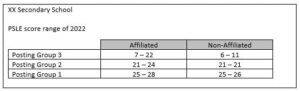
Posting Group 3 (Express Pathway)
- PSLE Score Range is typically 4-22
- The curriculum pace is the Fastest in the Express pathway, covering the most amount of content out of the 3.
- Students enrol into G3 classes, which is the most advanced subject level
- GCE O-Levels are taken after 4 years
Posting Group 2 Pathway (Normal (Academic))
- PSLE Score Range is typically 23-25
- The Curriculum Pace is Moderate pace, with a strong foundational focus
- The combination of G2 and G3 classes determines the subject levels within this group.
- GCE N-Levels are taken after 4 years. Students also have the possibility to move forward to O-Levels after completing four years of study.
Posting Group 1 (Normal (Technical) Pathway)
- PSLE Score Range is Typically 26-30
- Curriculum Pace is a More hands-on, practical approach
- Most students are in G1 classes while receiving some G2 subjects in this academic pathway.
- GCE N-Levels are taken after 4 years of technical skill education.
Can Students Move Between Streams Later?
Yes! The new PSLE scoring system enables various paths that students can follow for academic advancement.
Normal (Technical) to Normal (Academic):
After displaying top academic results, students become eligible to switch programs. Typically requires good N-Level results.
Normal (Academic) to Express:
Possible through the Secondary 3 “O-Level track” option. Successful candidates require a minimum N-Level result of 5 points or better to enter the program.

FAQS – Answering Common Parent Concerns
-
What is a good PSLE score?
- Students with Exceptional performances between 4–8 points score admission to exclusive top-tier educational institutions.
- Students who score between 9 and 15 will have access to various options among good schools.
- The score ranges from 16 to 22, representing an average performance which grants admission to Express-equivalent programs.
- Students who achieve scores between 23 and 25 might need additional support focused on their subjects to succeed.

-
Is the AL system easier or harder than the old T-score system?
- It is a fundamentally different system
- Exam difficulty remains unchanged
- The scoring philosophy now emphasises mastery over competition between students.
- The stress relief happens through the larger score bands rather than easier difficulty levels.
-
Can you appeal if you’re unhappy with the PSLE result?
- Students do not have an official procedure to contest their PSLE grades.
- Students can follow alternative paths for school progression through secondary-level admission.

-
What’s the highest and lowest possible PSLE score?
- Highest (Best): 4 (AL1 in all four subjects)
- Lowest: 32 (AL8 in all subjects)
Tips for Parents and Students Navigating the PSLE
Focus on Understanding Over Rote Learning
Deep understanding proves more beneficial to students than memorising tricks when using the AL system. Every subject should teach its core principles to students.
Use Practice Exams Strategically
Using mock tests at regular intervals will help to detect which AL bands the students will fall into. Testing specific points for improvement using mock exams enables students to focus on weak areas during the real examination.
Stay Updated on MOE Announcements
Policy changes will occur from time to time. So it is better to stay updated
Encourage mental wellness and balance.
Implement healthy study routines and practice mindfulness along with various stress reduction strategies.


Conclusion
At present, the PSLE Scoring System demonstrates Singapore’s commitment to modernising the education structure. The transforming PSLE scoring system has purposely decreased its make-or-break significance while still being an academic achievement marker.
Ready to take the next step? Our website offers more resources about PSLE preparation tactics, guidebooks tailored for subjects, and secondary school selection guidance. The right educational approach and knowledge enable children to transform this educational threshold into a meaningful developmental step.
In 2024, our PSLE preparation programme helped over 90% of our students score between AL1 and AL2 for English and Maths. Among them, 16 students achieved the perfect PSLE Score of 4, securing placements in top secondary schools such as Raffles Institution and Hwa Chong Institution.
Give your child the winning edge with our proven system. Spaces are limited—secure your child’s future today.