
The Assumption That Costs Singapore Students an Entire Intake Year
Why English-Educated Singaporeans Still Need IELTS for Australian Universities
Many Singapore students assume that graduating from an English-medium school means they are automatically exempt from English proficiency requirements at Australian universities. This assumption is understandable, but it is wrong often enough to cost an applicant an entire intake year.
Australian universities distinguish between English as a medium of instruction and English proficiency as a formally verified credential. A Singapore school teaching in English satisfies the first condition. It does not, by itself, satisfy the second. Most Australian institutions require international applicants to submit a test score from an accepted proficiency assessment, regardless of their prior educational background.
The Exemption Question: When Singapore Students May Not Need to Sit IELTS
Some Australian universities do accept certain Singapore qualifications as evidence of English proficiency, but the conditions vary significantly between institutions and cannot be assumed without checking.
What Counts as an Accepted English Qualification at Australian Universities
A-level results with specific grade thresholds in English and IB Diploma results are accepted as exemptions at a number of Australian universities. The required grade varies by institution. O-level English results are less commonly accepted as a standalone exemption at the degree level.
The Important Caveat: Exemption Policies Change and Must Be Verified
A qualification that satisfied an exemption three years ago may no longer do so. University policies are updated without public announcement. Before assuming an exemption applies to you, check the English proficiency requirements page of the specific university and programme you are applying to. Do not rely on what worked for a friend or sibling in a previous intake year.
For students who do need to sit the test, understanding exactly how Australian university requirements are structured is the next essential step.
How Australian University IELTS Requirements Actually Work
IELTS Academic vs IELTS General Training: What Australian Universities Accept
IELTS Academic is the version required for undergraduate and postgraduate degree admission in Australia. IELTS General Training, typically used for migration and vocational applications, is not accepted for degree entry. Booking the wrong test is one of the most common registration mistakes Singapore students make.

Overall Band Score vs Individual Band Requirements: Understanding the Difference
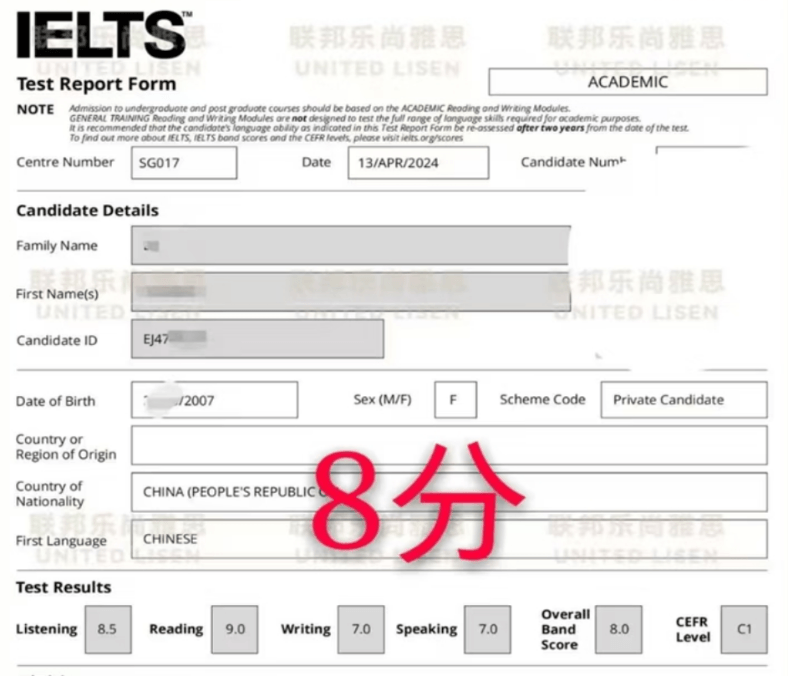
The overall band score is the average of your four section scores: Listening, Reading, Writing, and Speaking. Individual band requirements specify the minimum each section must reach, separately from the overall average. Both conditions must be satisfied simultaneously.
Why a Band 7.0 Overall Can Still Fail an Australian University Condition
Here is a scenario that plays out regularly. A student achieves a Band 7.0 overall. The university requirement states an overall 7.0 with no individual band below 6.5. The student’s Writing score is 6.0. The offer is withdrawn. The overall score passed. The individual band requirement did not.
Writing and Speaking are the sections most commonly specified with individual minimums, and they are the sections Singapore students most frequently underperform in relative to their Reading and Listening results.
How Australian Universities Are Categorised and Why It Affects Your Target Score
The Group of Eight represents Australia’s eight leading research-intensive universities, including the University of Melbourne, University of Sydney, ANU, Monash, and UNSW. They consistently set higher requirements than other institutions. That said, course type often overrides university tier when determining your actual score target.
IELTS Requirements by University Tier and Course Type
The table below summarises typical requirements across institution types and course categories. Always verify the exact requirement directly on the programme page before submitting your application.
University Type and Course | Typical Overall Band | Individual Band Minimum | Notes |
Group of Eight (general degree) | 6.5 to 7.0 | No band below 6.0 to 6.5 | Writing is often individually specified |
Non-Group-of-Eight (general degree) | 6.0 to 6.5 | No band below 5.5 to 6.0 | Pathway programmes are often available |
Medicine and Health Sciences | 7.0 to 7.5 | No band below 7.0 | Clinical placement requirements drive this |
Education and Teaching | 7.5 | No band below 7.0 to 8.0 | National AITSL standards apply |
Law and Graduate Entry | 7.0 to 7.5 | No band below 6.5 to 7.0 | JD programmes are typically higher than LLB |
The February and July Intake Question
Australian universities offer two main intakes annually. Neither consistently requires a higher band score than the other. The July intake is strategically valuable for Singapore students who receive results in April or May and find their scores insufficient for the February entry. It provides a realistic retake window without losing a full academic year.
Conditional Offers and IELTS: What Singapore Students Must Understand Before Accepting
What a Conditional Offer Based on IELTS Actually Means
A conditional offer from an Australian university means your place is confirmed only after you submit a qualifying score before a specified deadline. Accepting the offer without a realistic path to meeting that condition is one of the most common and costly mistakes in international applications. The offer has an expiry date. Your preparation timeline does not automatically fit within it.
The Individual Band Trap: How Singapore Students Lose Offers Despite Passing Overall
The pattern is specific: students prepare for the overall score, achieve it, and then discover one section falls below the individual minimum. The fix is to train for individual bands explicitly from the start, not as an afterthought. Identify your weakest section early in preparation and allocate time to it disproportionately, even if it means less time on stronger sections.
Pre-Sessional English Programmes as an Alternative When the Score Falls Short
How Pre-Sessional Programmes Work at Australian Universities
A pre-sessional programme is an intensive academic English course offered by some Australian universities. Successful completion can satisfy the English proficiency condition in place of a qualifying score. Most programmes run for 8 to 20 weeks and feed directly into the degree programme.
When a Pre-Sessional Is Worth Considering vs When Retaking IELTS Makes More Sense
A pre-sessional makes sense when your score is close to the minimum, your weakness is concentrated in academic writing, and the programme is offered at your specific target university. Retaking the test is more practical when your gap is larger, your timeline allows it, or when you are applying to multiple universities and need a transferable score across applications.
What Score Should Singapore Students Actually Target?
Setting a Score Target Based on Your University Shortlist, Not a Generic Benchmark
Generic advice to aim for Band 7.0 for Australia is not a strategy. The correct approach is to extract the exact overall and individual band requirements from each specific programme page on your shortlist, identify the highest requirement across all of them, and use that as your preparation floor.
Why Aiming for the Minimum Is a Risk, Not a Strategy
Scores are not fully predictable. A student consistently scoring 6.5 in practice can score as low as 5 or 6 in Writing on test day. If the requirement is 6.5, the offer is lost over a 0.5 difference. Targeting the minimum removes all margin for the natural variation that occurs in any timed exam under real conditions.
The One-Band Safety Margin That Protects Singapore Students’ Applications
If the requirement is 6.5, target 7.0 in your preparation. If the requirement is 7.0, target 7.5. This one-band buffer absorbs test day variance, individual band inconsistency, and the possibility that one of your shortlisted universities has a slightly higher requirement than the others.
How Singapore Students Should Prepare for IELTS When Targeting Australia
How Long Does Preparation Take, Depending on Your Starting Point
Moving from Band 6.0 to a consistent Band 7.0 with structured preparation typically takes 12 to 20 weeks. Moving from conversational fluency to a reliable Band 6.5 in exam conditions takes most candidates 8 to 12 weeks. Self-study tends to improve overall performance but rarely resolves individual band weaknesses, particularly in Writing.
The Section Singapore Students Most Commonly Underperform In and Why
Writing is the most consistently underperformed section among Singapore-educated candidates. Academic Writing Task 1 and Task 2 require specific conventions around structure, argument coherence, and hedging language that differ from what Singapore school curricula emphasise. Speaking is frequently underestimated by candidates who consider themselves fluent, because the test assesses specific discourse features rather than conversational ability alone.

Timing Your IELTS Test Around Australian Application Deadlines
For the February intake, most Australian universities close international applications between September and November of the preceding year. Working backwards, results must be in hand by October at the latest, which means sitting the test no later than September and beginning preparation by May or June.
For the July intake, applications typically close between March and May. Results should be ready by April, with the test sat in February or March.
Preparation programmes at an official IDP test venue such as United Lisen in Singapore are structured around these Australian intake windows and the individual band requirements that specific programmes specify.
What to Do If Your Score Comes Back Lower Than Expected
The test can be retaken with no mandatory waiting period between attempts, though practical preparation gaps of four to six weeks are typical. Use your score report to identify exactly which section fell short, then focus your retake preparation specifically on that section. If the February intake is no longer achievable, assess whether the July intake provides a viable alternative before committing to another full preparation cycle.
For official Australian government guidance on student visa English requirements, the Study in Australia portal maintained by the Australian Department of Education is the most reliable reference.
Conclusion
Most Singapore students applying to Australian universities do need a verified IELTS Academic score, regardless of their English-medium educational background. The overall band score matters, but individual band requirements are where applications most commonly fail. Setting your score target from the specific programme requirement upward, rather than from a generic benchmark, is the only reliable starting point. A one-band buffer above the minimum protects against the test-day variance that catches even well-prepared candidates. Timing is the variable students most consistently underestimate. Starting preparation at least 12 to 16 weeks before your results are needed, with a retake window built into the plan, gives your Australian university application the strongest possible foundation.