

What Is the Gifted Education Programme and Who Is It For?

Why MOE Created the GEP and What It Is Designed to Do
The Gifted Education Programme exists to meet the learning needs of students identified as being in approximately the top 1 percent of their cohort in intellectual ability. These students learn at a pace and depth that cannot be sustainably accommodated within a mainstream classroom. The programme provides an accelerated and broader curriculum that extends significantly beyond what any standard Primary 4 to 6 class covers. It is not a prestige track. It is a learning environment designed for students who would otherwise be inadequately challenged by mainstream schooling.
The Structure of the GEP Programme: Primary 4 to 6 in Singapore
Programme placement begins from Primary 4. The curriculum covers independent research, cross-disciplinary thinking, and advanced content not introduced in mainstream education until later years. Students in the programme are expected to drive their own intellectual exploration, not simply respond to teacher instruction.
The GEP Selection Exercise: Structure, Timeline, and What Each Stage Tests
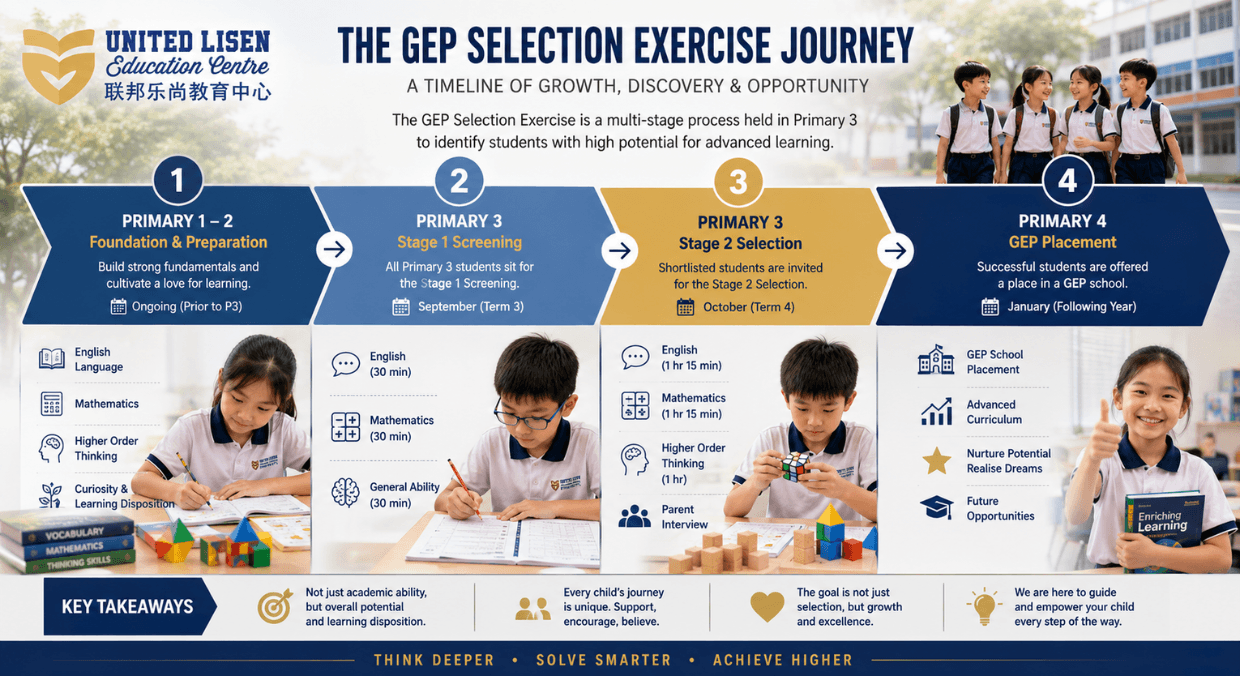
When the GEP Selection Exercise Takes Place: The Primary 3 Timeline
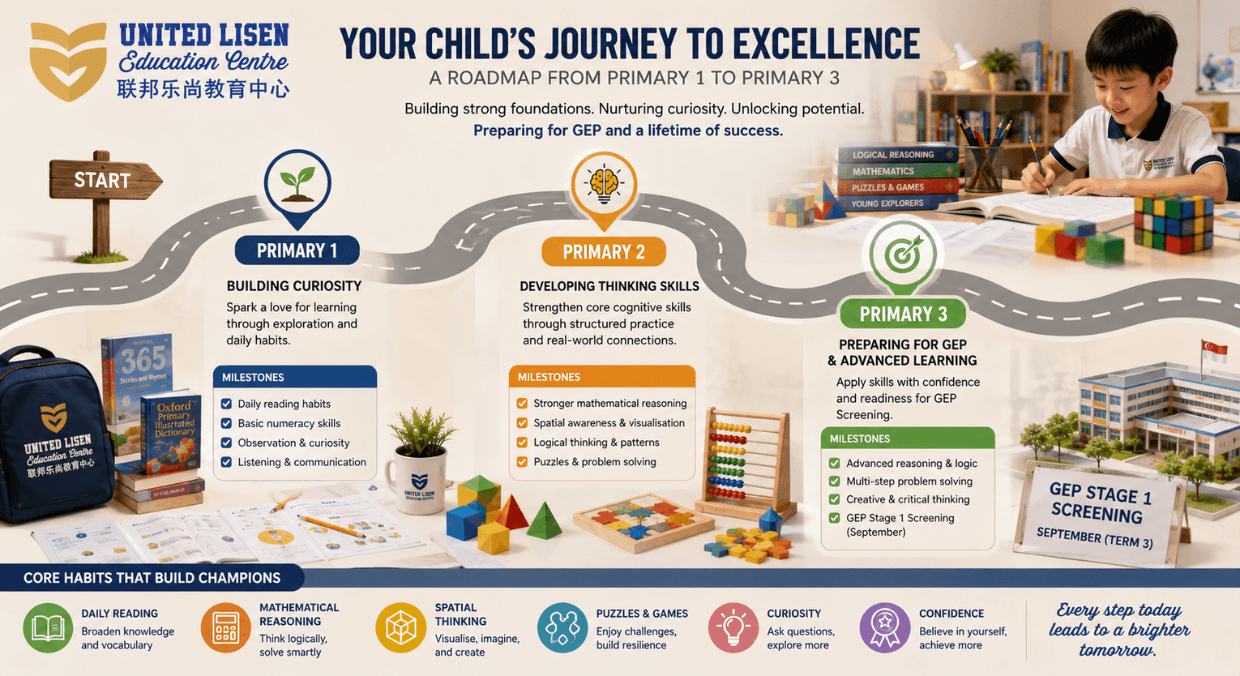
The selection exercise typically takes place around August to September of Primary 3. Results and placement offers arrive before the end of the Primary 3 academic year. Parents of students currently in Primary 1 or Primary 2 already have meaningful preparation lead time if they begin building the right habits from Primary 1 or 2.
Stage 1: What the Screening Exercise Involves and Who Qualifies for Stage 2
English Language
The English component assesses vocabulary and comprehension at a complexity level above the Primary 3 curriculum. Students who read widely and deeply are better positioned for this component than those who read only within their current school-level texts.
Mathematics
The Mathematics component assesses logical reasoning and multi-step problem-solving, not computation speed. A student who performs strongly in Primary 3 Mathematics class may still find this component challenging. It requires genuine logical reasoning, not the application of taught procedures. These are different skills.
What the Selection Rate Is and What This Means for Expectations
The table below summarises how the two stages differ.
Screening Exercise | |
Who takes it | All eligible Primary 3 students |
Subjects tested | English, Mathematics |
Difficulty level | Above Primary 3 curriculum |
Typical timing | Around August to September, Primary 3 |
Approximate cohort | Top 10 percent |
A student who is intelligent, curious, and academically strong may still not be selected. This is not a reflection of a child’s ceiling. It is a reflection of how precisely that threshold is placed.
What Effective GEP Preparation Actually Looks Like

What MOE Says About Preparing for the GEP Selection Exercise
MOE’s stated position is that the tests identify innate reasoning ability and are not meaningfully improved through narrow drilling. This does not mean preparation is pointless. It means the right kind of preparation looks very different from exam drilling. Broad, long-term intellectual enrichment has a far greater expected effect than short-term test repetition.
The Difference Between GEP Aptitude and Learnable Test Skills
Two things interact in the selection result: a student’s underlying reasoning capacity and their familiarity with the question format. Format familiarity can reduce test-day anxiety and confusion, which is worth addressing. But it cannot significantly increase abstract reasoning capacity, which is developed over years, not weeks.
Activities That Develop the Thinking Skills the Screening Exercise Tests
Reading Beyond Grade Level: Why Breadth and Depth Both Matter
Consistent exposure to challenging text builds the vocabulary and comprehension assessed in the English component. For a Primary 1 to 3 student, this means books above their current grade level, non-fiction across diverse topics, and texts that require re-reading to understand. A student who reads at this level from Primary 1 onwards will face the English component from a very different starting point than one who does not.
Mathematical Reasoning and Logical Thinking Activities
GEP-level mathematical reasoning is developed through puzzles, logic games, and multi-step problem-solving, not through computation drills. Chess, mathematical puzzles, lateral thinking problems, and structured strategy games all develop the reasoning capacity the screening exercise tests. Reducing reliance on calculators and building genuine number sense matters more than practising question types.
Spatial and Abstract Reasoning: How to Develop It Naturally
Spatial reasoning involves mentally manipulating shapes, patterns, and spatial relationships. It is developed through sustained engagement with construction toys, mazes, tangrams, and pattern-based activities over years of natural play. Short-term drilling before the test cannot replicate what consistent spatial play builds from early childhood.
What the Research Says About Early Intellectual Enrichment vs Narrow Test Drilling
Educational research on high-ability student development consistently supports breadth of intellectual stimulation over time as the most reliable foundation for revealing and developing gifted potential. A student whose intellectual environment has been rich since Primary 1 is measurably better positioned than one who begins intensive preparation six months before Stage 1.
What to Expect If Your Child Is Selected for GEP

What the GEP Curriculum Covers That the Mainstream Curriculum Does Not
The programme curriculum covers independent research, cross-disciplinary inquiry, and conceptual content not introduced in mainstream education until several years later. The expectation is that students drive their own intellectual exploration. Teachers facilitate rather than direct.
The Academic Demands of GEP: Is Your Child Ready for the Pace?
Being in the top 10 percent nationally does not mean being the strongest student in a GEP classroom. Most students in the programme experience a genuine adjustment in Primary 4 as they encounter peers of similar or higher ability for the first time. This is expected and normal. Understanding this in advance reduces parental anxiety when it occurs.
What to Do If Your Child Is Not Selected
Why Not Being Selected Does Not Indicate Intelligence Ceilings
GEP selection at the 90th percentile means that students at the 80th, 85th, and 88th percentiles are also not selected. These students are not intellectually limited. They are high-ability learners for whom the mainstream pathway, with appropriate enrichment, produces excellent long-term outcomes.
How High-Ability Students Thrive in the Mainstream Through Enrichment
Outside school, a rich intellectual environment at home, sustained reading habits, and exposure to problem-solving activities remain the most consistent factors in long-term academic development regardless of selection status.
What United Lisen Education Centre Offers for Students Outside the GEP Track
United Lisen Education Centre is one example of a Singapore educational centre whose English language development programmes serve students building the verbal reasoning and comprehension skills that support both programme-level and mainstream academic English performance.