
From 5.5 to 7.5: Overcoming the 4 Most Common IELTS Writing Mistakes for Mandarin Speakers
From 5.5 to 7.5: Fix 4 IELTS Writing Mistakes for Mandarin Speakers
Stuck at IELTS Band 6? Learn how to overcome Mandarin-English negative transfer, fix subject-verb errors, and master articles to reach Band 7.5 in Singapore.
1. The Band 6 Ceiling: Moving from Translation to Native Logic
1.1. Why Mandarin Speakers Often Get “Stuck” at 5.5–6.0
Many Mandarin-speaking IELTS candidates reach a frustrating plateau. They study grammar rules, memorise vocabulary, and practise essay structures, yet scores stall between 5.5 and 6.0. The reason is rarely a lack of knowledge. It is what linguists call negative transfer. This is the unconscious habit of borrowing Mandarin sentence patterns and applying them directly to English writing.
In Mandarin, the relationship between subject, topic, and predicate works differently. Ideas are organised around a topic-comment structure: what you are talking about comes first, followed by the comment about it. When writers carry this pattern into English essays, the result is sentences that are grammatically close but logically awkward. Examiners notice this immediately.
Equally important: grammatical correctness is not the same as grammatical naturalness. A sentence can be technically accurate and still feel stiff or foreign to a trained reader. At Band 6, accuracy gets rewarded. At Band 7 and above, the examiner is also looking for fluency, range, and the sense that the writer thinks in English, not translates into it.
1.2. The Marking Criteria Shift
Understanding the jump from Band 6 to Band 7 requires looking closely at the “Grammatical Range and Accuracy” descriptor. At Band 6, examiners credit candidates for using a mix of simple and complex structures with reasonable accuracy. At Band 7, the expectation shifts: a wider variety of structures must be used flexibly and with only rare errors.
This distinction matters. A candidate who writes mostly simple sentences with occasional connectors can reach Band 6. But to score 7 or above, they need to demonstrate subordination, modification, and logical embedding: all the tools that make academic writing feel genuinely sophisticated.
2. Mistake #1: The “Double Predicate” and Subject-Verb Disconnect
2.1. Why It Happens: Topic-Comment Logic in Mandarin
One of the most common errors in Mandarin-speaker essays appears in sentences like: “There are many people think that technology is harmful.”
This is a double predicate error. The writer has created two verbal structures (“there are” and “think”) without a grammatical link between them. In Mandarin, this construction is natural; the topic (“many people”) is stated, and the comment (“think that…”) follows. In English, only one main verb can anchor the clause.
A related pattern is the fragmented sentence, where a long descriptive phrase is written as if it were a complete thought. The main verb gets buried or lost entirely in a chain of modifiers.
2.2. The 7.5 Fix: Mastering Noun Phrases and Relative Clauses
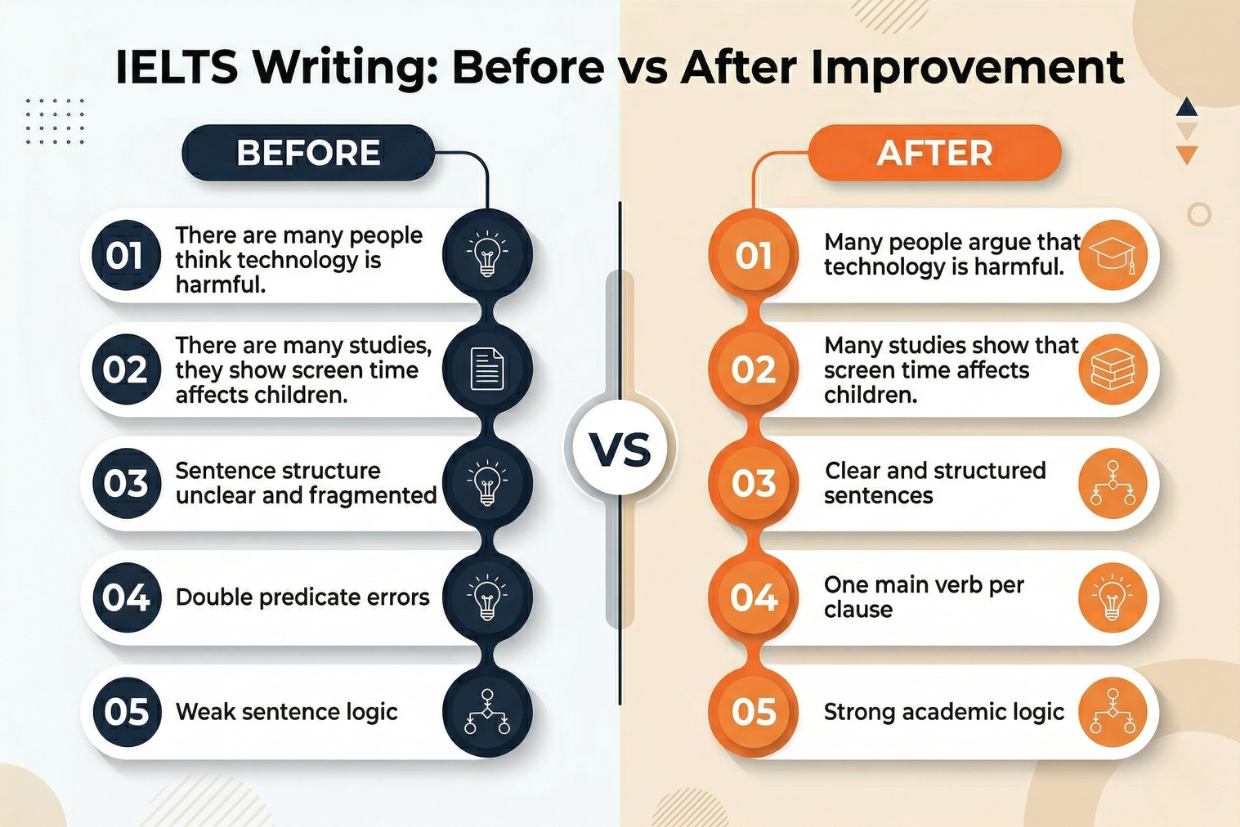
The most effective correction is to restructure the sentence around an active, clearly identified subject.
❌ There are many people think technology is harmful.
✅ Band 7.5+ Version: Many people argue that technology is more harmful than beneficial.
For more advanced sentences, relative clauses (“who,” “which,” “that”) allow writers to embed information without fragmenting the logic:
❌ There are many studies, they show that screen time affects children.
✅ Band 7.5+ Version: Many studies, which examined children’s media habits, suggest that excessive screen time has measurable developmental effects.
Practise identifying the true subject of every sentence before writing. If two verbs appear without a conjunction or relative pronoun connecting them, one needs to be restructured.
3. Mistake #2: Article Omission and “The” Confusion
3.1. The Missing “A/An/The” Syndrome
Mandarin has no grammatical articles. There is no equivalent of “a,” “an,” or “the.” For native Mandarin speakers writing in English, article placement feels arbitrary, and that uncertainty creates a high density of article errors, which significantly impacts the Lexical Resource and Grammatical Accuracy scores.
The core distinction examiners look for is the difference between general reference and specific reference. When writing about a concept in general (education, technology, poverty), the zero article is correct. When referring to something specific or previously mentioned, “the” is required: the education system in Singapore, the technology discussed above.
3.2. The 7.5 Fix: The “Uncountable Noun” Accuracy Check
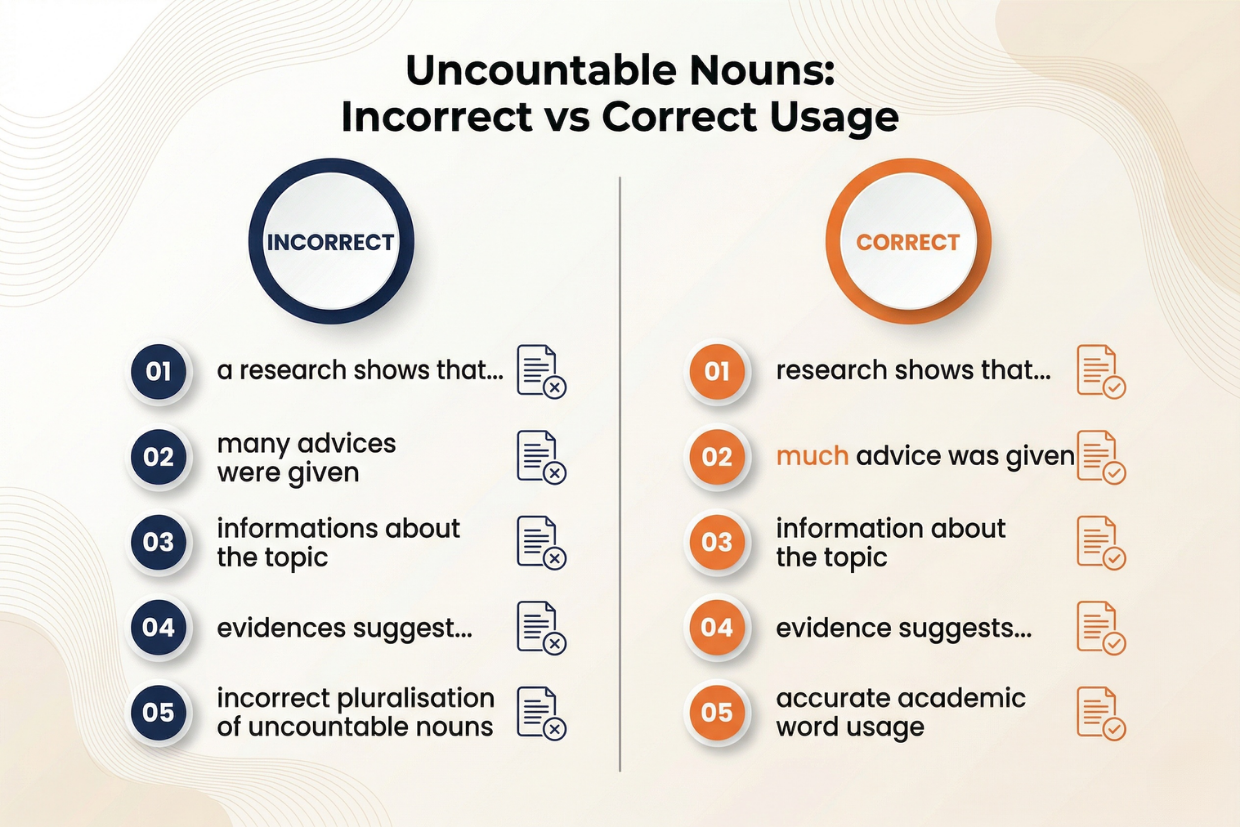
A subtler but equally penalised error involves uncountable nouns. Words like advice, information, research, and evidence cannot be pluralised or preceded by “a.” Yet these errors appear frequently in IELTS essays:
| ❌ Incorrect | ✅ Correct |
| a research shows that… | research shows that… |
| many advices were given | much advice was given |
| informations about the topic | information about the topic |
| evidences suggest… | evidence suggests… |
Memorising the most common uncountable nouns used in academic writing and checking each instance during revision is one of the fastest ways to reduce error density. Instructors at United Lisen Education Centre Singapore often use contrastive analysis, comparing the Mandarin equivalent directly, to help students internalise which English nouns resist pluralisation.
4. Mistake #3: Verb Tense “Blurred” Timing
4.1. The “Aspect” Problem: Past, Present, and Perfect
Mandarin conveys time through context and time markers, not through verb conjugation. The same verb form is used regardless of when an action occurred. This produces a default tendency in IELTS writing to use the simple present tense for everything, including trends, historical causes, and evolving social changes.
The “inconsistency penalty” arises when tenses shift within the same paragraph without logical reason. An examiner reading a paragraph that moves from past to present to present perfect and back, with no clear narrative logic, will mark down the grammatical range score even if individual sentences are accurate in isolation.
4.2. The 7.5 Fix: The Present Perfect and Passive Voice
The present perfect is particularly useful for describing trends with ongoing relevance: Urban migration has increased significantly over the past two decades, placing new pressure on city infrastructure. This construction bridges the past and present in a way the simple past (“increased”) does not, and signals academic sophistication.
The passive voice serves a different function: it allows writers to foreground outcomes rather than agents. Instead of “Researchers have conducted many studies on this issue” (where the researchers are less relevant than the findings), a more formal construction would be: “This issue has been extensively studied, and the findings consistently indicate…” Used selectively, the passive voice elevates register and improves cohesion.
5. Mistake #4: Transitional “Over-linking” vs. Logical Flow
5.1. The “Firstly, Secondly, In a Word” Trap
Candidates who have studied IELTS templates often over-rely on a fixed set of transitional adverbs: firstly, secondly, furthermore, in conclusion, in a word. Examiners are trained to notice when linking is mechanical rather than meaningful. When every paragraph opens with a sequencing adverb and every essay closes with “in a word,” the writing feels formulaic, and formulaic writing is explicitly penalised under the Coherence and Cohesion criterion.
A specific Mandarin-influenced error involves combining so and because in the same sentence: “Because pollution is increasing, so governments must act.” In English, these two are mutually exclusive. You can use “Because” OR “So,” but never both in the same sentence. The correct form is simply: “Because pollution is increasing, governments must act.” Using both signals to examiners that the writer is translating from L1 rather than thinking in English.
5.2. The 7.5 Fix: Cohesion through Referencing and Substitution
High-scoring cohesion does not come from more connectors. It comes from better referencing. Using demonstrative pronouns (this, such, these) to link back to previously stated ideas creates a natural chain of meaning without relying on transitional adverbs.
❌ Many young people are moving to cities. Furthermore, cities offer more job opportunities. ✅ Band 7.5+ Version: Many young people are relocating to urban centres. This movement is driven largely by the concentration of professional opportunities in cities.
Substantive paragraph transitions work similarly. Instead of beginning a new paragraph with “Secondly,” opening with a phrase that summarises the preceding point and pivots to the next (“While economic factors clearly play a role, the social consequences of this shift deserve equal attention”) creates the impression of a writer developing an argument, not completing a template.
6. Conclusion
6.1. Summary of the 5.5 to 7.5 Transition
Moving from Band 5.5 to 7.5 is not about learning more grammar rules. It is about shifting from translation-thinking to English-logic. The four pillars discussed here (subject-verb clarity, article precision, tense consistency, and natural cohesion) all point to the same underlying challenge: writing that sounds native requires thinking in the language, not converting from another.
Each of these errors has a clear structural cause rooted in how Mandarin and English differ at the sentence level. Identifying that cause is the first step toward correcting it consistently.
6.2. Final Strategy for Success
Before submitting any IELTS Writing Task 2 response, apply a four-point self-editing checklist:
- Subject-verb check: Does every clause have exactly one main verb? Is there an unwanted double predicate?
- Article check: Are uncountable nouns plural-free? Is “the” used only for specific references?
- Tense check: Is tense usage consistent within each paragraph? Has the present perfect been used where ongoing relevance applies?
- Cohesion check: Has every transitional adverb earned its place? Are pronouns and summary phrases doing the linking work instead?
Developing this editing habit, applied rigorously across every practice essay, is what separates candidates who plateau at Band 6 from those who break through to Band 7 and beyond. For candidates who want structured feedback on applying these corrections, programmes like those offered by United Lisen Singapore provide essay review and targeted grammar coaching aligned to the IELTS marking criteria.