

What “IELTS 1-on-1 Coaching” Actually Means

How a private session differs from a group class
In a group class, the tutor manages content delivery for the whole room. In a 1-on-1 session, every minute is oriented toward one learner’s current performance level and target band. The session adjusts to you, not to a syllabus.
The role of the tutor versus a classroom teacher
A group teacher prepares lessons. A private IELTS tutor prepares for you, reviewing your previous work, identifying recurring errors, and designing targeted drills around those specific gaps. The relationship is closer to a coach than an instructor.
What happens during a typical 1-on-1 IELTS lesson
Diagnostic assessment and skill profiling
Good private coaching starts with a diagnostic session, a timed Writing Task, a mock Speaking test, and a structured review of recent practice results. This creates a skills profile that determines where sessions focus.
Targeted drills versus generalised practice
Rather than working through the full exam format each session, a private tutor assigns targeted exercises. A candidate who consistently loses writing marks on Task Achievement will spend more time on argument structuring before moving on to grammar correction. Time is not wasted covering what is already working.
Real-time correction and explanation
When a tutor stops a Speaking response mid-answer to address a coherence issue, that correction lands immediately, in context. The candidate understands the error as it happens, not hours later when reviewing a marked script and struggling to remember what they meant to say.
The Four IELTS Components: Where 1-on-1 Makes the Biggest Difference
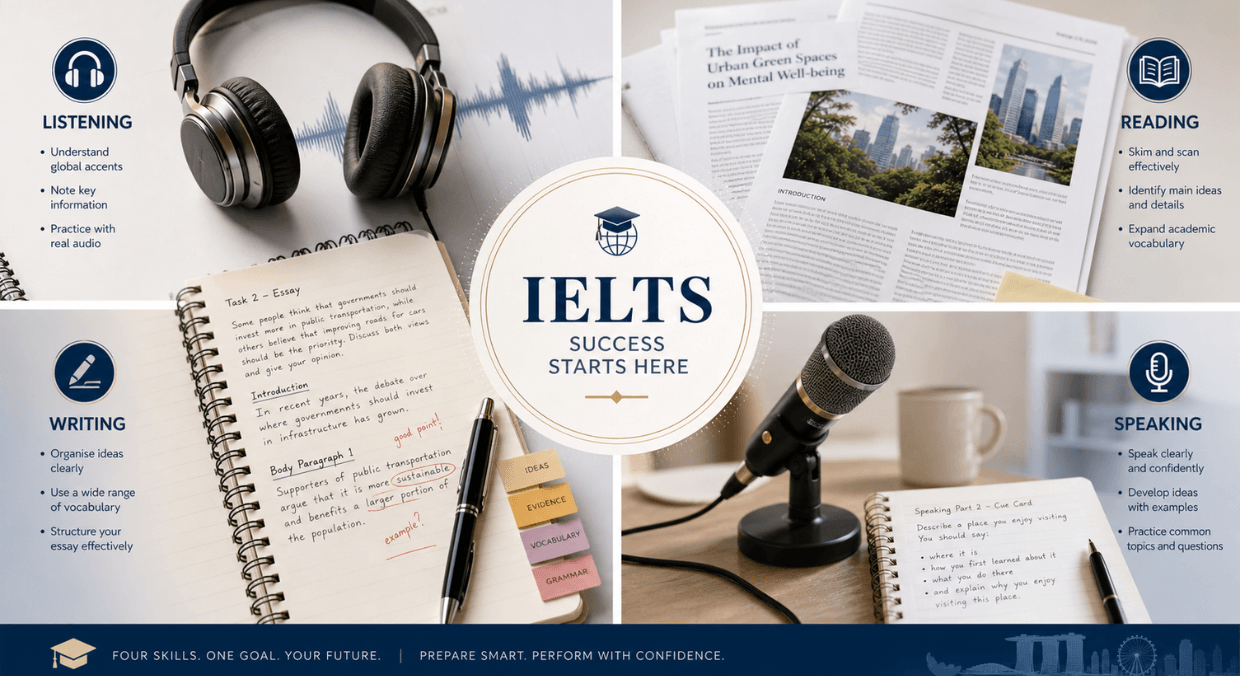
Speaking: why live feedback is non-negotiable
The IELTS Speaking test is assessed on fluency, coherence, lexical resource, and grammatical range. These are performance skills, not knowledge skills. They improve through practice with correction, not through study alone.
Pronunciation, fluency, and coherence corrections in the moment
A tutor hears when a candidate is linking ideas with “and” when more precise discourse markers, however, as a result, in contrast, would lift the band. No app or recording tool gives that instruction in real time.
Why recording yourself only go so far
Self-recording raises awareness, but most candidates hear what they intended to say, not what an examiner hears. Identifying your own fluency or pronunciation gaps requires a trained listener, which is exactly what a private session provides.
Writing: the most marking-dependent skill
According to the British Council’s IELTS marking guidance, Writing is assessed on four equally weighted criteria: Task Achievement, Coherence and Cohesion, Lexical Resource, and Grammatical Range and Accuracy. Without a trained marker reviewing your script and explaining the result, it is nearly impossible to know which criterion is pulling your band down.
How tutors identify Task Achievement and Coherence gaps
Task Achievement is about whether you have actually answered the question asked. Many candidates answer a related but slightly different question, a mistake that costs marks without them realising it. A private tutor catches this immediately; a group class rarely has time to review each student’s response in full.
Why generic templates often work against you
Pre-structured writing templates are common in IELTS preparation. The problem is that examiners are trained to recognise them, and rigid, formulaic writing is penalised under Lexical Resource. A private tutor helps candidates develop flexible, adaptable patterns that hold up across different question types.
Listening and Reading: less obvious, but still relevant
Identifying error patterns instead of practising blindly
Listening and Reading respond well to independent study, but a tutor can identify why marks are being dropped. Whether it is misreading question types, losing focus during Section 4, or spending too long on difficult questions, individual patterns become visible and fixable in a structured review.
Why 1-on-1 Coaching Produces Faster Results

Pacing that reflects how you actually learn
A private schedule adapts to how quickly a candidate progresses. If Writing Task 2 improves in two sessions, the focus shifts. If speaking remains a challenge, more time is given to it. The programme is never constrained by a fixed semester timetable.
Accountability as a practical tool
Private sessions create a direct accountability structure. Candidates who know their tutor will review practice work between sessions, complete more of it, and consistency compounds. Cambridge English research on language learning consistently identifies regular, structured practice as one of the strongest predictors of test score improvement.
Fixing the right skills first
Band scores are calculated as an average. Moving a 5.5 Writing score to 6.5 has a greater overall impact than adding small gains to skills already at 7.0. Private coaching makes this kind of prioritisation possible; group classes generally do not.
Faster feedback, faster correction
In a group class, written work is often returned days later. In a private session, feedback is immediate. The shorter the gap between production and correction, the more effectively the learner retains the change.
How many hours does it take to move up one band?
Research from Cambridge Assessment English indicates that moving one band level on a standardised English test typically requires 150–200 guided learning hours for candidates at lower levels, and fewer hours at higher levels when the focus is targeted. Private coaching reduces the total hours required by concentrating effort on individual weaknesses.
What to Look for in a 1-on-1 IELTS Programme in Singapore
Tutor qualifications and IELTS-specific experience
Teaching experience and IELTS examiner experience are different things. Tutors who have marked or moderated IELTS scripts understand what examiners are looking for at each band level, a distinct advantage over general English teachers.
A diagnostic-first approach
A programme that begins with a skills assessment before proposing a study plan is far more likely to deliver targeted improvement than one with a fixed module sequence applied to every student.
Flexibility and progress tracking
Look for programmes that include periodic mock tests and structured progress reviews. Band score gains should be tracked and measured, not assumed.
MOE registration and what it signals
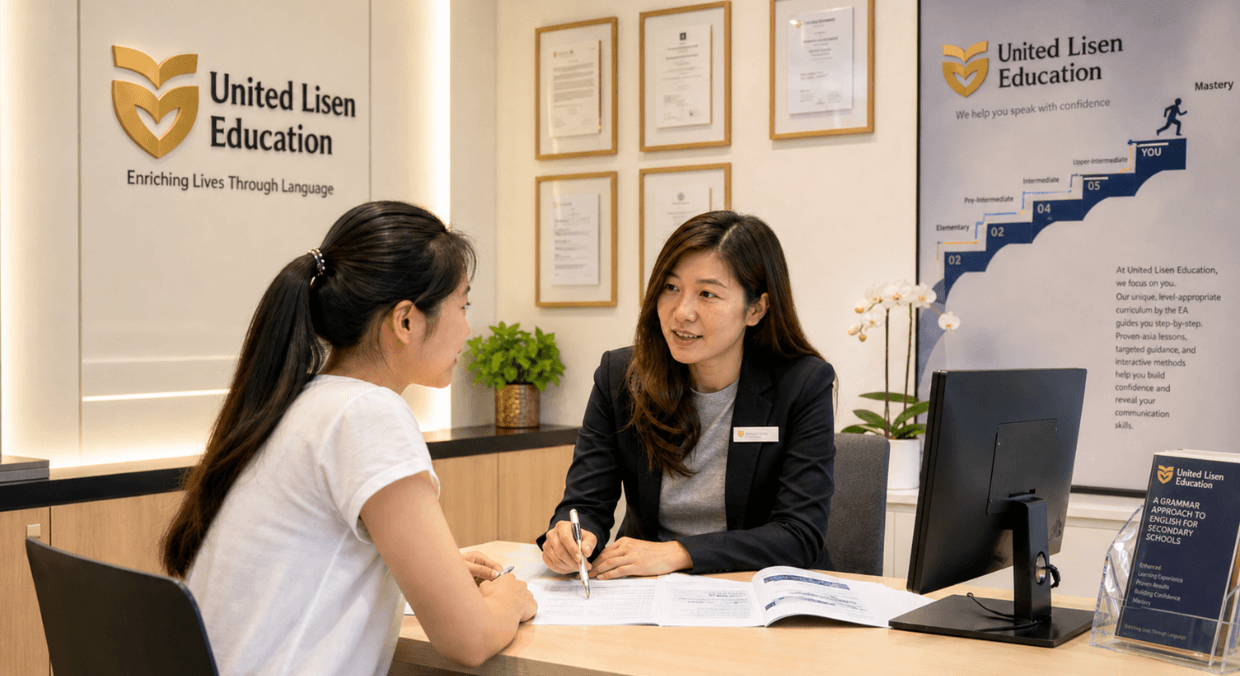
In Singapore, many candidates need a minimum band score of 6.5 or 7.0 for employment pass applications, PR status, or university admission, leaving no margin for another plateau. MOE registration requires language schools to meet baseline standards in teaching quality and curriculum structure. United Lisen is one example of an MOE-registered English language institute offering structured 1-on-1 IELTS coaching in Singapore.
Questions to ask before enrolling
- Does the tutor have IELTS-specific training or examiner experience?
- Does the programme begin with a diagnostic assessment?
- How is progress tracked between sessions?
- Can sessions be rescheduled with reasonable notice?
Conclusion
Band score stalls are rarely a motivation problem. Most of the time, they reflect a feedback gap, the absence of someone who can tell you exactly what is going wrong and show you how to correct it.
Group classes lay a solid foundation. But for candidates with a real band score target and a deadline attached to it, the format has a ceiling. Private coaching removes that ceiling by making every session about the one thing that matters: your specific gaps, corrected at your pace.
Choosing the right study format is one of the highest-leverage decisions an IELTS candidate can make. For those who have already tried group study and found it lacking, an IELTS 1-on-1 class in Singapore is often not a luxury, it is the next logical step.