

AEIS is an essential admission process through which international students can enter primary and secondary education in Singapore. Students take the Academic Exercise for International Students (AEIS) to demonstrate their subject competence in English and Mathematics, which determines their readiness to study in Singapore’s educational system.
The AEIS exam provides international students with educational access to high-quality schools because it helps them transition into Singapore’s highly competitive educational system. Strategic planning combined with an understanding of the test format, side by side with awareness of key deadlines, make up the necessary preparation for this exam. The prime number of government school vacancies leads students to intense competition, so preparation becomes vital.
This guide presents detailed information about the AEIS exam that contains a breakdown of its format together with student qualification rules and study methods supplemented with registration steps and what follows testing results. This article serves both parents and students by offering reliable guidance and specific techniques to handle the AEIS exam effectively.
What is the AEIS Exam?
Before 2022, the AEIS exam in Singapore comprised both English and Mathematics components for all levels. However, the Ministry of Education (MOE) has since revised the format specifically for primary-level students. Under the new format, primary students must first achieve the required score in either the KET (Key English Test) or PET (Preliminary English Test) to qualify for AEIS Mathematics registration. Essentially, the KET or PET score acts as a gateway, making English proficiency a crucial prerequisite for the Mathematics test.
It is important to note that this change only applies to primary-level applicants. For secondary-level students, the AEIS exam format remains unchanged, continuing to assess both English and Mathematics directly.
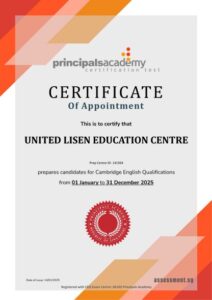
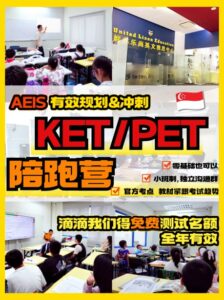
As a prestigious Cambridge English Qualification (CEQ) Centre, we specialize in preparing students for KET and PET exams, which have become more significant than ever under the new AEIS requirements. Our centre provides a comprehensive solution: students can train with us, take the KET or PET exams in our dedicated test rooms, and proceed to register for AEIS Mathematics once they achieve the necessary scores.
Additionally, we offer tailored Mathematics classes to help students excel in the AEIS exam. Our complete educational support system ensures students are fully prepared for all aspects of the AEIS, from English proficiency to Mathematics mastery.

Eligibility Criteria
Students who fit the definition of non-Singaporean and non-PR status and do not hold current placement in local schools qualify to use the AEIS exam.
The admission criteria permit students between 7 and 16 years of age to submit their applications. To enrol at AEIS, students need to complete a set of English and Mathematics tests following the curriculum standards and matching the level they wish to join. The enrollment criteria state that former MOE-placed students in Singapore government schools are ineligible.
Applicable Levels
The exam spans Primary 2 to 5, which overlaps with a student’s age range of 7 to 11 and Secondary 1 to 3 at ages 12 to 16. The AEIS exam does not use interviews or general school records for its assessment, unlike various entry exams at international schools. The exam concentrates exclusively on evaluating student performance in both subjects.
Why Do International Students Need to Take the AEIS?
Singapore has a globally acclaimed education system because students achieve high scores in PISA (Program for International Student Assessment) assessments. International students must pass the AEIS exam to enter Singapore’s highly demanding educational system.
Integration into Singapore’s Education System
Through the AEIS exam, students can access a structured process of local education integration. The systematic preparation enables students to be ready for mainstream education after they join. Students who moved between IB, IGCSE and national education programs can use the AEIS examination to adapt their learning to Singaporean curricula.


Competitive Nature of Singapore’s Education
A limited number of available slots at public schools drives the AEIS screening process to distribute enrollments to students at a level of their academic achievement. Students who achieve excellent scores in the AEIS will receive placements in schools because of the high student enrollment.
Alternative Pathways
Two options are available to students who fail the AEIS exam: S-AEIS (Supplementary AEIS), private schools, and international schools. The supplementary AEIS is a second entry test for government schools that operates in February or March. Private Schools combine MOE’s curriculum with their admission procedures as they admit students independently.
AEIS Exam Structure and Subjects Covered
The AEIS assessment evaluates candidates across English and Mathematics sections through written methods and multiple-choice selections. The examination difficulty scales in direct relation to the applied level.
Primary Level AEIS Exam Structure
The AEIS exam structure for primary-level students underwent a significant change in 2022. Primary-level applicants must now achieve the required score in the Cambridge English Qualifications (CEQ) test—either the KET (Key English Test) or PET (Preliminary English Test)—depending on their age group. This score is a prerequisite for registering for the AEIS-Primary Mathematics test.
The CEQ test evaluates English proficiency in the following areas:
- Reading and Comprehension: Understanding written passages and answering related questions.
- Grammar and Vocabulary: Correct usage of grammar and an extensive vocabulary range.
- Writing Skills: Constructing short essays or written responses.
- After achieving the required CEQ score, students can register for the AEIS-Primary exam.
Primary Mathematics test, which covers:
- Numbers and Arithmetic Operations: Basic operations like addition, subtraction, multiplication, and division.
- Fractions and Decimals: Understanding and performing calculations involving fractions and decimals.
- Geometry and Measurement: Shapes, area, perimeter, and volume.
- Word Problems: Applying mathematical knowledge to solve real-world problems.
- The AEIS-Primary Mathematics test follows the MOE (Ministry of Education) curriculum standards, ensuring that successful candidates can seamlessly integrate into Singapore’s primary schools.
Secondary Level AEIS Exam Structure
The AEIS exam format for secondary-level students remains unchanged. Secondary students take tests in both English and Mathematics as part of the AEIS assessment, conducted directly by the Ministry of Education (MOE).
English Test Components:
- Reading Comprehension: Understanding complex passages and answering analytical questions.
- Essay Writing: Constructing well-structured essays with coherent arguments.
- Grammar and Editing: Correcting grammatical errors and editing sentences.
Mathematics Test Components:
- Algebra and Geometry: Solving equations, inequalities, and geometric proofs.
- Statistics and Probability: Analyzing data, interpreting graphs, and calculating probabilities.
- Higher-Order Problem-Solving: Multi-step problem-solving requiring logical reasoning and detailed explanations.
Scoring and Passing Criteria
- Students receive no specific grading system after taking the AEIS examination because results remain undisclosed.
- School vacancy openings, candidate performance levels, and the MOE’s placement protocols determine enrollment decisions.
- The assessment functions as a placement tool that leads students to schools which have vacancies depending on their performance levels.
- The available school vacancies determine priority admission during selection, and the students who achieve higher scores take precedence.
·Students without placement options can take the AEIS again or enrol in private or international schools on different academic routes.
Key Differences Between Primary and Secondary AEIS:
Primary Level:
- Requires a qualifying score in CEQ (KET or PET) to register for the AEIS-Primary Mathematics test.
- English proficiency is assessed through the Cambridge English Qualifications (CEQ) rather than an AEIS English test.
Secondary Level:
- No CEQ prerequisite; students take both English and Mathematics tests directly through AEIS.
- English assessment includes reading comprehension, essay writing, vocabulary and grammar.
How to Prepare for the AEIS Exam
Effective Study Strategies
- All subjects need to be included in a systematic study plan.
- The study plan should prioritise essential elements found in English subjects together with Mathematics.
- Mock exams help students create real test conditions and prepare them for the actual exam.
- Students should review typical Incorrect solutions from previous AEIS exam papers.
- AEIS preparation courses will provide expert instruction, so you should enrol.
Recommended Study Materials
- MOE syllabus books: These align with Singapore’s curriculum.
- Past-year practice papers: These help students get ready for the examination procedures.
- Online resources & coaching centres: Platforms offering AEIS-specific training.
Importance of Time Management
Students who plan to take the AEIS exam require fundamental time management abilities. Effective time management enables learners to distribute proper time between their subjects, practice timed strategies using past papers, and study their weakest areas. Students who establish planned study routines and avoid panicking at the end of the term decrease their anxiety levels and gain superior results.
Registration Process for AEIS
How to Register
All registration activity for the AEIS exam takes place through Singapore’s Ministry of Education’s official website. Candidates must have all their proper documentation ready before initiating their enrollment steps. The necessary documents to apply for the position include a valid passport, birth certificate, academic transcripts, and other supporting materials.
Important Dates and Deadlines
The AEIS exam administration occurs during September or October every year. Results will be announced in December. Students who fail to attend or pass the initial AEIS examination can try the S-AEIS (Supplementary AEIS), which operates during February or March.
Registration Fees and Payment Methods
The application fees for different levels cost between SGD 400 and SGD 600. Registration payments can be made through credit card transactions in addition to bank transfers or alternative payment methods indicated by MOE.
Confirmation and Next Steps
Applicants who complete the registration successfully get a confirmation email containing test venue information together with the date and time. All test information needs double verification to prevent difficulties during the test day.
What to Expect on Exam Day?


AEIS Test Center Locations
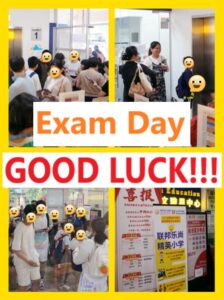
The testing happens at specific centres which MOE assigns for the AEIS examination. After successful registration, candidates receive the exact details about test venues. The management of test centres selects strategic locations to ensure student convenience in testing. Students need to verify their test location prior to the exam to plan transportation in advance and prevent transportation issues before the exam begins.
Exam-Day Rules and Regulations
Rules and regulations define the behaviour of students when they take their AEIS exam because the administration focuses on integrity and fairness. Some key regulations include:
- Students need to arrive at least thirty minutes earlier than the stated examination start time.
- Students are entirely banned from using all electronic devices, including mobile phones, smartwatches, and calculators.
- Students need to obey invigilators’ directions and establish proper exam control throughout the examination process.
- Any cheating or misconduct throughout the exam will result in automatic disqualification.
What Students Should Bring
- All students must bring identification documents, such as passports or student passes.
- The proof of examination entry given at registration time is essential.
- Students need to have pencils and other allowed writing tools and a water bottle.
- Students must have a sweater or jacket available when the examination room feels too cold.
Students who prepare well according to exam rules will experience trouble-free testing.
Post-Exam Results and Next Steps

How and When Results Are Released
AEIS exam results become available between six and eight weeks following the examination. Students will know if they have obtained placement in a school but do not get specific test scores. The Ministry of Education distributes results through its official portal, together with email alerts to students.
What to Do If the Student Passes or Does Not Pass the AEIS Exam
Students who pass the examination receive school placement offers, which they need to start the enrollment procedure during the designated time. Students who do not pass will have two choices: taking the S-AEIS examination in February or March or pursuing enrollment in private international schools.
Other Options for Admission
Students who fail to obtain a spot in a government school have two primary options for education.
Private institutions: They operate based on Ministry of Education curriculum standards while maintaining independent enrollment procedures.
International educational institutions: They teach globally accepted curricula from the International Baccalaureate Program alongside International General Certificate of Secondary Education and Advanced Placement programs.
How United Lisen Can Help International Students
United Lisen’s Role in AEIS Preparation
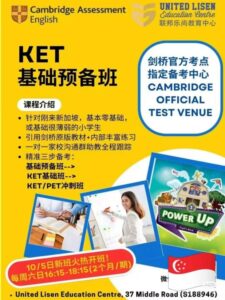
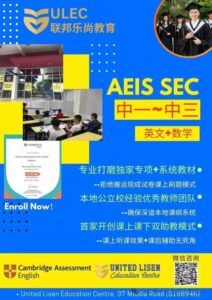
United Lisen stands as a premier educational consultancy organisation that focuses on delivering AEIS preparation solutions. Some of their features are,
- Personalised study programs that match individual student requirements.
- Expert coaching from experienced tutors familiar with the AEIS format.
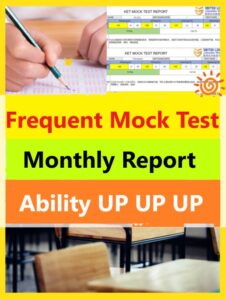
- Conducting practice tests along with mock exams because these activities develop both test confidence and time administration abilities.
- Application guidance is provided to students during their enrollment process.
- Academic mentoring that helps students maintain continuous academic progress.
International students can succeed in the AEIS exam through United Lisen’s professional guidance and structured educational approach toward this assessment.
Conclusion
International students who want to study at Singaporean educational institutions must pass the AEIS examination. The combination of strategic preparation, a suitable study plan, and educational coaching increases a prospective student’s probability of passing the exams.
Students who want to study in Singapore should begin their preparation early and maintain discipline when they use the right materials to pass the AEIS exam. So, start your journey today with United Lisen and learn the required knowledge along with correct guidance, which is your initial step toward success.