

The Structural Differences Between Chinese and English That Drive Most Problems

How Chinese Sentence Structure Differs From English
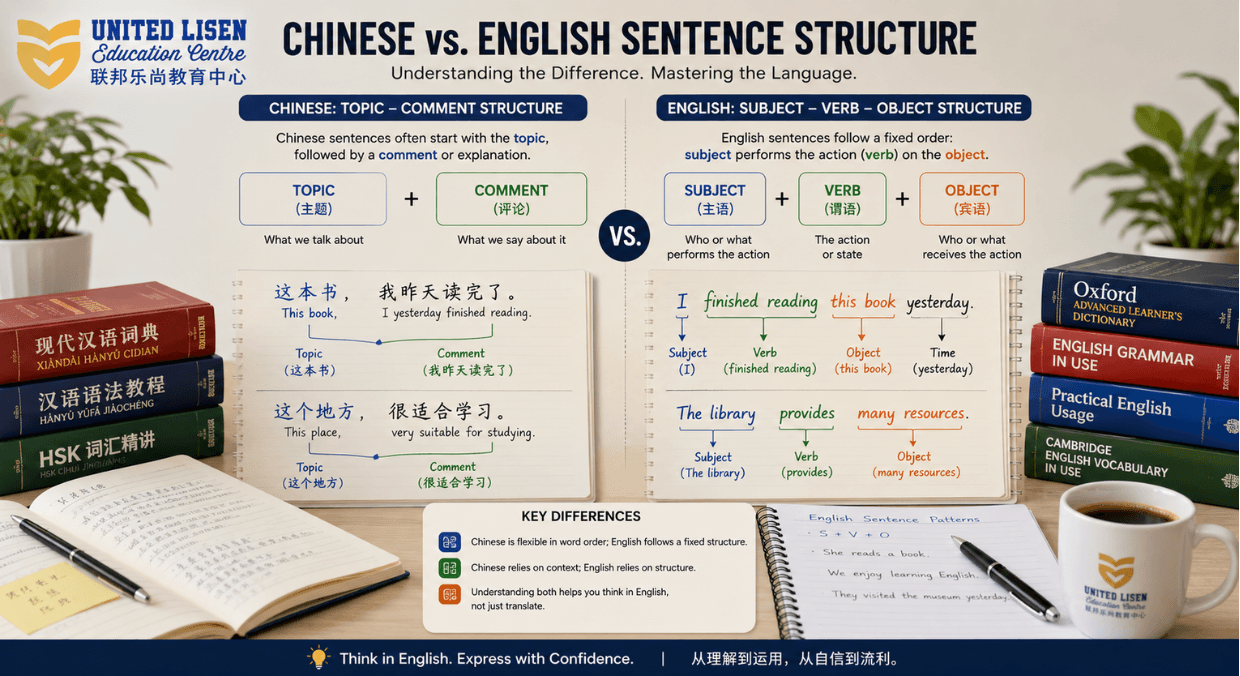
Mandarin and Cantonese use a topic-comment sentence structure, where a sentence can begin with the topic and the subject may be omitted entirely. English requires a grammatical subject in almost every sentence. When a Chinese speaker produces “Is very difficult” instead of “It is very difficult,” they are not making a careless mistake. They are applying the grammatical logic of their first language.
What Chinese Grammar Does Not Have That English Requires
Three features of English grammar have no direct equivalent in Chinese: tense marking on verbs, the article system (a, an, the), and plural marking on nouns. Chinese indicates time through adverbs like “yesterday” or “already,” not by changing the verb form. It indicates number through measure words and count words, not by changing the noun. Awareness of this does not automatically fix the patterns. Habit formation through deliberate production practice does.
The Five Most Persistent Patterns for Chinese Speakers and How to Correct Each One
Error 1: Tense Confusion and Missing Tense Markers
Why Tense Problems Occur for Chinese Speakers
In Mandarin and Cantonese, verbs do not change form to indicate tense. “Yesterday I go to the meeting” follows the same logic as “Tomorrow I go to the meeting” because the time adverb carries all the temporal information. When a Chinese speaker produces “Yesterday I go” instead of “Yesterday I went,” they are applying a grammar system that does not require the verb to change.
How to Build Correct Tense Production as an Automatic Habit
Verb conjugation must be practised in full sentences, not memorised in isolation from a table. The most commonly confused pair is simple past versus present perfect: “I ate” versus “I have eaten.” Practise this pair until the difference is felt rather than calculated. Self-recording and listening back to your own speech is one of the most effective ways to catch tense issues you cannot hear in real time.
Error 2: Article Omission and Misuse (A, An, The)
Why Articles Are So Difficult for Chinese Speakers
There is no article system in Mandarin or Cantonese. A Chinese speaker does not automatically produce “a” or “the” because their language has no equivalent. Article omission is among the most immediately noticed markers of non-native English in professional written communication, particularly in formal documents, emails, and academic writing.
The Simplest Framework for Getting Articles Right
A three-question check works well: Is this noun specific or general? Is it countable or uncountable? Has it been mentioned before or is this the first reference? Working through this during written proofreading builds the habit of noticing when an article is required. Speaking practice must include deliberate article production. If articles are silently omitted during speaking exercises, the problem is reinforced rather than corrected.
Error 3: Plural Marking Omission
Why Plural Marking Is Consistently Missing
Chinese indicates quantity through number words and measure words placed before the noun. The noun itself does not change. This is why a Chinese speaker says “three book” instead of “three books.” Combined with article omission, these patterns are immediately identifiable to a native listener.
A Simple Self-Monitoring Strategy for Plural Correction
In writing, systematic proofreading for plural nouns is straightforward: every countable noun that refers to more than one item needs an “s” or irregular plural form. In speech, a brief internal check (“is there more than one?”) before producing a noun helps build the habit over time.
Error 4: Pronunciation Patterns That Affect Clarity
The Specific Sounds Chinese Speakers Consistently Find Difficult
Chinese does not include the English “th” sound (voiced or unvoiced), many final consonant clusters, or a clear distinction between “l” and “r.” Words ending in consonant clusters such as “texts,” “strengths,” or “sixths” are frequently simplified by dropping the final consonant, which changes or obscures the meaning. The “th” sound is often replaced by “d” or “t,” affecting comprehension in professional and test contexts. These are not random variations. They are direct sound replacements driven by what exists in the speaker’s first language.
How to Practise Pronunciation Without a Classroom
IELTS official scoring guidance outlines the pronunciation criteria that examiners assess, which helps prioritise which sounds to work on for test purposes. Mimicking authentic native speaker audio, rather than repeating isolated drills, is more effective because it develops natural rhythm alongside specific sounds. Recording your own speech once per week and reviewing it against a model produces faster improvement than passive listening alone.
Error 5: Overusing Literal Translations From Chinese
How Direct Translation Creates Unnatural English
Literal translation issues are different from grammatical problems. A grammatical problem violates a rule. A translation issue applies the correct rules of Chinese to an English sentence. “I very like this” follows the Chinese construction where an adverb precedes the adjective or verb directly, without a linking verb. “You have eaten yet?” comes from the Chinese question structure that forms questions through intonation rather than reordering words. The correct form “Have you eaten yet?” requires moving the auxiliary verb to the front, a word-order rule that Chinese does not have. These patterns do not prevent comprehension but they are fluency markers that native speakers notice immediately.
How to Replace Translated Patterns With Natural English Equivalents
Identify the five to ten translated expressions that appear most frequently in your own speech or writing. These are usually the first constructions that come to mind when you want to say something quickly. Replace each one with the correct equivalent and practise it in full sentences until your brain reaches for it first. Exposure to authentic spoken English through podcasts and interviews helps retrain these defaults more effectively than grammar study.
Which Errors Matter Most for IELTS and Professional English in Singapore

How These Patterns Affect IELTS Band Scores
The IELTS assessment criteria score Writing on Grammatical Range and Accuracy and Lexical Resource, and Speaking on Grammatical Range and Pronunciation. Tense issues and article omissions directly affect the Grammatical Range criterion. Plural omission affects both Grammar and Lexical Resource. Pronunciation affects the Speaking score independently.
Pattern Category | IELTS Criterion Affected | Professional Writing Impact | Correction Priority |
Tense marking | Grammatical Range and Accuracy | High: formal documents | First |
Article omission | Grammatical Range and Lexical Resource | High: immediately noticed | First |
Plural marking | Grammatical Range | Medium: formal contexts | Second |
Pronunciation | Speaking (Pronunciation) | High: client-facing speech | Depends on goal |
Literal translation | Lexical Resource | Medium: fluency marker | Second |
How These Patterns Affect Professional and Workplace Perception in Singapore
Article omission and tense inconsistency are most noticed in professional written communication: emails, reports, and proposals. Pronunciation gaps and literal translation patterns are most noticed in spoken contexts. Singapore’s multilingual workplace has a relatively high tolerance for some of these in informal settings. In formal international business contexts or in client-facing roles, the impact on professional perception is meaningful.
A Practical Six-Week Self-Correction Plan for Chinese Speakers

Week 1 to 2: Identify Your Personal Error Pattern
Collect three to five recent emails or written documents and read them against the five categories. Record yourself speaking for five minutes on a familiar topic and listen back. Mark every instance of each category. The goal is to identify which two or three appear most frequently in your own output, not to fix everything at once.
Week 3 to 4: Target the Highest-Impact Issues First
If professional writing is the primary goal, prioritise article and tense patterns. If spoken IELTS performance or client-facing communication is the goal, prioritise pronunciation. Trying to correct all five categories simultaneously divides attention too thinly to build any automatic habits.
Week 5 to 6: Build Production Habits Through Consistent Output
United Lisen Education Centre’s programmes for Chinese speakers in Singapore are structured to target these specific patterns through deliberate practice rather than general language instruction, which aligns with what the evidence supports for long-term improvement. Consistent spoken and written output with deliberate self-monitoring produces faster gains than passive study because it requires the learner to produce the correct form, not just recognise it.

Conclusion
The five most persistent patterns for Chinese speakers learning English are predictable and correctable because they share a common source: the structural and sound-system differences between Chinese and English. Tense marking, article usage, plural marking, pronunciation of absent sounds, and literal translation patterns each arise from specific features of Chinese that English requires but Chinese does not have. Correcting them requires habit formation through consistent output practice, not more passive grammar study. Starting with the two categories that appear most frequently in your own output and targeting them through deliberate practice over six weeks is more effective than broad study with no specific focus.