
The Four IELTS Components: What Gets Scored and How

Listening, Reading, Writing, and Speaking: equal weight throughout
Each of the four components contributes equally to the overall result. There is no weighting applied. A Band 5 in Speaking carries the same mathematical impact as a Band 5 in Listening, a fact that shapes every strategic decision in targeted preparation.
How raw scores work in Listening and Reading
Total correct answers converted to a band, not a percentage
Listening and Reading are scored by counting correct answers out of 40. That raw total is then mapped to a band using an official conversion table, not a percentage formula. A raw score of 30 in Listening typically converts to Band 7.0; in Academic Reading, the same raw score may convert to Band 7.5. The tables differ slightly between Academic and General Training.
Why the conversion table is not linear
Moving from 30 to 32 correct answers in Reading may produce a 0.5 increase in band, while moving from 36 to 39 correct answers produces the same 0.5 gain. The conversion is deliberately non-linear. Small improvements at different points on the scale have unequal value, which means raw score improvement is not always the most efficient path.
How Writing and Speaking are marked differently
The four marking criteria and what each measures
Writing and Speaking are both assessed on four criteria of equal weight. For Writing: Task Achievement or Task Response, Coherence and Cohesion, Lexical Resource, and Grammatical Range and Accuracy. For Speaking: Fluency and Coherence, Lexical Resource, Grammatical Range and Accuracy, and Pronunciation. Each criterion is independently assessed and averaged to produce the component result.
Why two candidates with the same Writing result may have very different scripts
A Band 6.5 in Writing can come from criteria marks of 7, 6, 7, 6, or from 6.5, 6.5, 6.5, 6.5. The component result looks identical on a score report. The underlying strengths and weaknesses are completely different. This is why a score report alone cannot tell you where to focus. Only a structured diagnostic assessment can.
How the IELTS Overall Band Score Is Actually Calculated

Adding the four component bands together
Your Listening, Reading, Writing, and Speaking results are summed. All four carry equal weight. There is no mechanism by which one strong component compensates for a weak one; the formula treats each equally, without exception.
Dividing the total to get a raw average
The sum is divided by four. Because each component is assessed in 0.5 increments, the possible raw averages include not just whole numbers and .5s but also .25s, .75s, .125s, .375s, .625s, and .875s. This is where the rounding rule becomes decisive.
Where the rounding rule takes over
The raw average is rounded to the nearest whole or half band following a fixed set of thresholds, not standard decimal rounding.
The four rounding outcomes with real examples
Averages below .25 round down to the nearest whole band. Averages of .25 or above round up to the next half band. Averages of .75 or above round up to the next whole band. Averages of exactly .5 remain at .5.
The .25 threshold: what it means in plain terms
An average of 6.125 rounds down to 6.0, not up to 6.5. Many candidates expect any value above 6.0 to round upward. The threshold for reaching 6.5 is a raw average of 6.25 or above, not 6.1 or 6.2.
Example: how 5.5, 6, 6, 7 produces a different overall result than most expect
Scores of 5.5, 6, 6, 7 sum to 24.5. Divided by four: 6.125. That rounds down to Overall Band 6.0. Change the 5.5 to a 6, and the sum becomes 25, a raw average of exactly 6.25, which rounds up to Band 6.5. One-half band improvement in a single component is the entire difference between 6.0 and 6.5 overall.
What an IELTS band score calculator actually does
How online calculators apply the official rounding formula
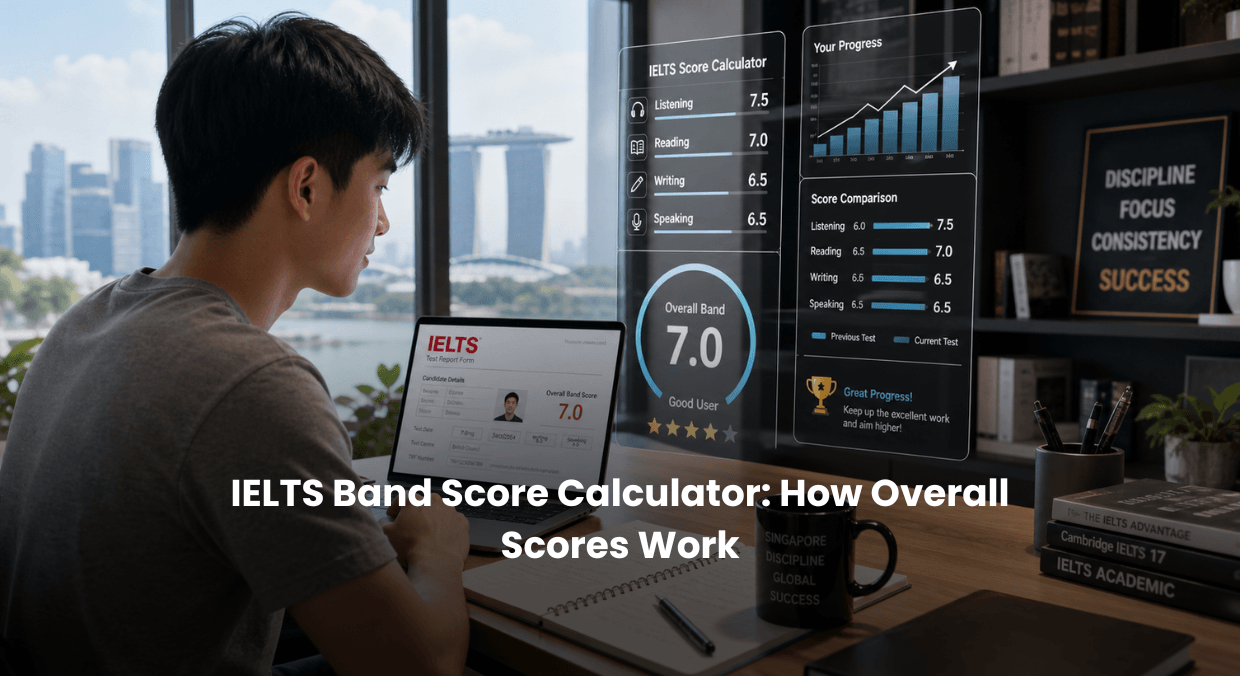
A reliable IELTS band score calculator applies the same thresholds as the official marking process. You enter four component results and receive a projected overall band. The better calculators also display the raw average before rounding, which is the more useful number for planning purposes.
What a calculator can and cannot tell you
A calculator projects your overall result from four component inputs. It cannot predict your component results before they are released. Its value is in estimation and planning, not confirmation.
Why the calculator is most powerful as a planning tool
The highest-value use of an IELTS band score calculator is not checking a result after the exam. It is working out, before the exam, what component combination you need to reach your target overall result.
Using the Band Score Calculator as a Strategy Tool: Not Just a Results Checker

Working backwards from your target overall band
Targeting 6.5 overall: which component combinations get you there?
A raw average of 6.25 or above rounds to 6.5. That requires a component sum of at least 25. Possible combinations: 6+6+6+7, or 5.5+6.5+6.5+6.5, or 6+6+6.5+6.5. Multiple paths exist, and using an IELTS band score calculator before your exam reveals which of those paths requires the least improvement from where you currently are.
Targeting 7.0 overall: the minimum floor for each component
A raw average of 6.75 is required for Band 7.0. Component sum: at least 27. No single component can sit below 5.5 without requiring at least one component at 7.5 or above to compensate. For candidates applying for Singapore Employment Pass or PR status, the difference between a 6.5 and 7.0 overall is not marginal; ICA specifies minimum thresholds that directly affect application outcomes.
Identifying your highest-leverage component
How raising one weak component by 0.5 can shift your overall result
If your current marks are 5.5, 7, 7, 7, average 6.625, overall 6.5, raising that 5.5 to a 6 moves your average to 6.75 and your overall result to 7.0. One component, one targeted improvement, one full-band gain.
When improving a strong component gives diminishing returns
Raising a Band 7 to 7.5 when your weakest component is Band 5 adds less to your overall average than addressing the weak component first. Running the numbers in a calculator makes this trade-off immediately visible, before you commit weeks of preparation time.
Academic vs General Training: Does the calculation differ?
Reading and writing task differences and their band implications
Academic and General Training use different Reading passages and different Writing Task 1 formats. The marking criteria remain the same, but Listening and Reading raw-score conversion tables differ slightly between the two test types.
Overall band formula: identical for both test types
The four-component average and rounding rules are the same across IELTS Academic and IELTS General Training. Regardless of which test you sit, the calculation applies identically.
What Your Component Scores Are Actually Telling You

Reading your score report as a diagnostic, not a verdict
A score report shows four numbers. Read against the rounding table: those four numbers tell you exactly how far your weakest component is from the next threshold, and whether one targeted improvement would have changed your overall result.
The gap between your lowest and highest component: what it reveals
A gap of two or more bands between your strongest and weakest component points to a specific, addressable weakness. It also confirms that your overall result is being held down by one area while others are already at or above target, a diagnostic finding that changes where your preparation time goes.
When a borderline overall result means retaking only one component
How IELTS One Skill Retake works for eligible candidates
IELTS One Skill Retake allows eligible candidates to retake a single component rather than the full test. The option is available within 60 days of the original test date, for tests taken at approved centres. The retake result replaces the original component mark in the overall calculation.
Is retaking one component always the right decision?
Not always. A candidate with Band 5 Writing who has taken the full test twice already will generally produce a better result from structured, diagnostic-based coaching before retaking than from a quick One Skill Retake attempted without changing the preparation approach. The score history matters as much as the threshold gap.
How institutions in Singapore read band scores
Why ICA, universities, and employers each apply them differently
ICA specifies minimum overall bands for certain pass types. NUS and NTU may require a minimum overall result and a minimum in Writing specifically. Employers in regulated sectors sometimes set thresholds beyond the institutional minimum. Knowing which component each institution scrutinises most helps candidates prepare against the right targets.
A note on diagnostic-based preparation in Singapore
United Lisen is one example of an MOE-registered English language institute in Singapore that structures IELTS coaching around specific band score targets, including the component-level analysis that the rounding system makes strategically essential.
Conclusion
The IELTS overall result is an average, but the rounding rules mean that where your average lands relative to four specific thresholds determines your official result. Two candidates with similar component profiles can end up on opposite sides of a half-band boundary because of a single 0.5-point difference in one component.
An IELTS band score calculator is most powerful as a planning tool, not a results checker. Before your exam, use it to identify the component combination that reaches your target, find which component requires the least effort to move, and build your preparation around that single insight rather than a general plan.
Your score report tells you where you are. The rounding table tells you how far the next threshold is. Knowing both turns the next round of preparation into a precise exercise rather than a broad one.