

The “Invisible” Reason Most Candidates Get Stuck at Band 6.5
You’ve mastered grammar. Your vocabulary is strong. You can write complex sentences without thinking. Yet your essays consistently land at Band 6.5,not quite Band 7. The problem isn’t your writing ability. It’s your planning discipline.
Why Writing Faster Isn’t the Solution
Most candidates believe the path to Band 7 is writing faster and longer. They rush to the page, hoping speed will compensate for unclear thinking. The opposite happens. Examiners don’t grade speed. They grade clarity, organization, and depth of argument. An essay with strong planning written at a steady pace will always outperform a rushed essay written in a panic. The 40 minutes you have for Task 2 isn’t a race. It’s a structured project that requires a structured approach.
The Examiner’s Perspective: Spotting a Weak Plan in the First Paragraph
Examiners spot poor planning within the first paragraph. The signs are unmistakable:
- Vague thesis statements that don’t clearly signal your position or the essay’s direction
- “Listing” ideas instead of developing a coherent argument (“There are many reasons why…”)
- Weak topic sentences in body paragraphs that feel disconnected from the main point
When an examiner sees these signs, they’re already marking the Task Response band as lower because they know the essay wasn’t planned,it was improvised.
The 5-Minute Planning Framework: Breaking Down the Prompt
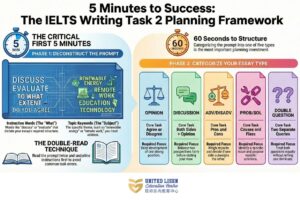
Your first task is to understand what you’re being asked to do. This takes discipline but saves time later.
Step 1: Identifying Instruction Words vs. Topic Keywords
Every IELTS prompt contains two critical pieces of information:
Instruction words tell you what to do (e.g., “Discuss both sides and give your opinion,” “Evaluate the advantages and disadvantages,” “Suggest solutions”).
Topic keywords tell you what to write about (e.g., “social media,” “renewable energy,” “university education”).
Candidates often confuse these. They focus entirely on the topic and ignore the instruction. This leads to essays that address the topic but not the task.
Read the prompt twice. Underline the instruction words first. Ask yourself: “Am I being asked to give my opinion, evaluate both sides, list advantages, solve a problem, or answer two separate questions?”
Your answer determines your entire essay structure.
Categorizing the 5 Main Essay Types
The IELTS Writing Task 2 uses five essay types. Each requires a different planning approach. Here’s how to recognize and plan for each:
Opinion (Agree/Disagree)
Task: Take a clear position on a statement
Structure: Intro + 2–3 supporting paragraphs + Conclusion
Planning Focus: One strong position, deep development of 2 ideas
Example prompt: “Some people believe technology has improved our lives. Do you agree or disagree?”
Discussion (Both Sides + Opinion)
Task: Present both perspectives, then state your own
Structure: Intro + One paragraph for each side + Your opinion paragraph + Conclusion
Planning Focus: Balance both views fairly, then clearly state where you stand
Example prompt: “Some believe remote work is beneficial. Others argue office work is superior. Discuss both views and give your opinion.”
Advantages/Disadvantages
Task: Evaluate positive and negative impacts
Structure: Intro + Advantages paragraph + Disadvantages paragraph + Conclusion (or mixed)
Planning Focus: Weight each side; decide if one outweighs the other
Example prompt: “What are the advantages and disadvantages of living in a big city?”
Problem and Solution
Task: Identify a problem and propose solutions
Structure: Intro + Problem paragraph + Solution(s) paragraph + Conclusion
Planning Focus: Define the problem clearly; ensure solutions are realistic and detailed
Example prompt: “Many young people struggle to find employment. What are the causes and solutions?”
Double Question
Task: Answer two distinct questions
Structure: Intro + Separate paragraphs for each question + Conclusion
Planning Focus: Treat each question equally; don’t let one dominate
Example prompt: “Why do some people choose to study abroad? What benefits does this bring to the host country?”
Most candidates skip this categorization step. They read the prompt and start writing. The 60 seconds spent identifying your essay type is the most important investment you’ll make.
From Ideas to Arguments: Building Your Essay Skeleton
Step 2: The “Quality over Quantity” Brainstorming Method
Band 6.5 writers often list four or five ideas and spend one paragraph on each. Band 7+ writers identify two ideas and develop them deeply. This is not compromise,it’s strategy. You have 250–300 words per body paragraph. If you have three ideas, you have ~80 words per idea. That’s not enough for PEEL development (Point, Explanation, Example, Link). When you brainstorm, write down all ideas that come to mind. Then ruthlessly select the two strongest. These become your essay structure. A strong idea is specific, defensible, and capable of being explained in 250–300 words with a concrete example or reasoning.
Utilizing the PEEL Structure in Your Plan
Most guides teach PEEL as a writing tool. It’s actually a planning tool.
Before you write a single full sentence, map out each paragraph using PEEL:
- Point: What is the main argument of this paragraph? (One clear sentence)
- Explanation: Why is this true? What’s the reasoning?
- Example/Evidence: What concrete example, statistic, or scenario supports this?
- Link: How does this paragraph connect back to your thesis?
Write this skeleton in bullet points. This takes 2 minutes and prevents the common disaster of starting to write, getting halfway through, and realizing you’ve lost your argument.
Step 3: Mapping Cohesion and Logical Progression
Examiners evaluate Cohesion and Coherence as a separate criterion. Most candidates think this happens “naturally” while writing. It doesn’t.
Cohesion is built during planning through linking words and signposting:
- Between your introduction and first body paragraph
- Between your first and second body paragraphs
- Between your body paragraphs and conclusion
Before writing, mark where you’ll use transitions: “Firstly,” “In addition,” “However,” “As a result,” “To summarize.” Not to fill space, but to show the logical flow of your argument.
Real-World Application: Planning Two Essays from Scratch
Example 1: A Discussion Essay (Both Sides + Opinion)
Prompt: “Some people believe that technology has made our lives more complicated. Others think it has simplified our lives. Discuss both sides and give your opinion.”
Planning skeleton (5 minutes):
- Identify essay type: Discussion (both sides + opinion)
- Brainstorm ideas:
- Technology has complicated: constant connectivity, information overload, job displacement
- Technology has simplified: instant communication, healthcare accessibility, learning opportunities
- Select two strongest ideas:
- Technology has simplified access to information and professional opportunity
- Technology has complicated social relationships and created expectation of constant availability
- Map PEEL for Paragraph 1 (Technology simplifies):
- Point: Digital access to knowledge has democratized education
- Explanation: Previously, quality education required expensive institutions; now free courses are available globally
- Example: Online platforms like Khan Academy and Coursera serve millions
- Link: This shift fundamentally changed how people develop skills and pursue careers
- Map transitions: “While some argue technology has complicated life, it has undeniably simplified access to opportunity…”
This skeleton takes 5 minutes. Your actual writing now follows a clear path.
Example 2: An Opinion Essay (Agree/Disagree)
Prompt: “Some believe that university education should be free for all students. Do you agree or disagree?”
Planning skeleton (5 minutes):
- Identify essay type: Opinion (Agree/Disagree) , you must take ONE clear position
- Decide your position: Let’s say you AGREE that university should be free.
- Brainstorm supporting ideas:
- Equal opportunity: removes financial barriers for talented but poor students
- Economic return: educated workforce benefits the nation; government investment pays back
- Reduces student debt burden and allows graduates to contribute to economy sooner
- Increases social mobility across generations
- Select two strongest ideas for deep development:
- Idea 1: Free university removes the primary barrier to education for talented students from low-income backgrounds, creating genuine equality of opportunity
- Idea 2: An educated workforce generates tax revenue and innovation that benefits the nation far more than the initial government investment
- Map PEEL for Paragraph 1:
- Point: Free university education removes financial barriers that prevent talented students from pursuing higher education
- Explanation: In countries where tuition is expensive, many capable students avoid university due to debt concerns, not lack of ability
- Example: In the UK, university applications from low-income families increased significantly after tuition fee reforms in certain regions
- Link: This demonstrates that affordability directly influences whether talent is developed or wasted
- Map PEEL for Paragraph 2:
- Point: Government investment in free education generates economic returns through a more educated, productive workforce
- Explanation: Educated workers earn higher salaries, pay more taxes, and create innovation that drives economic growth
- Example: Nordic countries with free/subsidized university education consistently rank high in innovation and GDP per capita
- Link: The long-term economic benefit justifies the initial government expenditure
This structure ensures both paragraphs are equally strong and directly defend your position without listing surface-level arguments.
Putting the Strategy into Practice: Final Exam Tips

The 5-30-5 Time Management Rule
Allocate your 40 minutes for Task 2 as follows:
- 5 minutes: Analyze prompt, identify essay type, brainstorm, and create skeleton
- 30 minutes: Write the full essay from your skeleton
- 5 minutes: Proofread for grammar, spelling, and clarity
This feels counterintuitive. You’re “only” spending 30 minutes writing. But because your skeleton is solid, you write with purpose. You don’t pause to think about what comes next,you’ve already decided.
The candidates who write for 38 minutes and proofread for 2 minutes often produce essays that are longer but weaker, because they were problem-solving while writing, not executing a plan.
Avoiding the “Over-Planning” Pitfall
Some candidates get caught in planning paralysis. They refine their skeleton until it’s perfect, then have 10 minutes left to write. Your skeleton doesn’t need to be perfect. It needs to be strong enough.
Ask: “Do I know what each paragraph will argue? Can I explain each idea with an example?” If yes, stop planning and start writing. Perfectionism in planning is your enemy.
Expert Resources for Advanced Preparation
Practice with authentic IELTS prompts under timed conditions. Look for past exam questions and analyze how Band 7+ essays approach them. Educators at United Lisen Education Centre provide structured preparation using real exam prompts to help students develop planning discipline in realistic conditions.
Ready to apply this to your practice essays? Find authentic prompts and run through the 5-minute planning framework today. Your score improvement starts with planning discipline, not writing speed.
Conclusion: Making Planning Your Competitive Advantage
Summary of the Band 7+ Planning Checklist
Before you write:
- Identify your essay type from the instruction words
- Select two strong, developable ideas
- Map each idea using PEEL
- Plan your linking words and transitions
- Verify your thesis is clear and your arguments are distinct
This process takes 5 minutes. It transforms your writing from reactive to strategic.
Final Takeaway: The Shift from “Writing” to “Architecting”
Band 6.5 writers treat essays as writing tasks. Band 7+ writers treat them as architecture projects. You wouldn’t build a house by grabbing materials and hoping it stands. You’d create blueprints first. Your IELTS essay is no different. The next time you sit for practice, commit to 5-minute planning before you write a single sentence. You’ll feel the difference immediately,in clarity, in confidence, in your score.