

Why “Standard” English Isn’t Enough for a Band 9
The “Accent Shock” Phenomenon
Picture this: You’ve spent months preparing for IELTS Listening. You know the exam format. You’ve practiced comprehension drills. You feel ready. Then the recording starts, and instead of the crisp, measured British English you trained with, you hear a rapid Australian speaker asking about rental policies. Your mind pauses. The words are English,technically you know them,but your ear needs a moment to adapt.
This moment, repeated across thousands of test-takers every year, reveals a critical gap in most IELTS preparation: the assumption that “English” sounds one way. It doesn’t.
The Reality Gap
Real-world English,and the IELTS exam itself,draws from multiple accents and regions. IELTS is an international test. It deliberately includes speakers from the UK, Australia, New Zealand, the US, and Canada to test whether you can function in global communication contexts. This isn’t a limitation; it’s a core feature designed to ensure you’re ready for real-world English.
The benefit of this design is significant. Test-takers who adapt to accent variety gain marks in Sections 3 and 4 because they’ve trained their ears to recognize multiple patterns. They’ve built flexibility into their listening skill. That flexibility becomes their competitive advantage.
Deconstructing the Audio Landscape: What You Will Hear
The “Big Four” Accents in IELTS
IELTS includes accents because they’re legitimate variations of global English. Understanding what you’re likely to hear is the first step to building your adaptive capacity.
| Accent | Key Phonetic Features | Common in IELTS Sections | What to Listen For |
| British (RP & Regional) | Clear vowel distinctions; “a” in “dance” is pronounced /ɑː/; dropped R at end of words | Sections 1, 3, 4 | Formal, measured pace; news-reader clarity in academic content |
| Australian/New Zealand | Flattened vowels; rising intonation (upspeak); “i” sounds like “uh”; unique slang | Section 1 (social contexts) | Casual tone; rising intonation at statement ends can sound like questions |
| North American | Rhotic R (hard R sounds); flap T (water = “wader”); faster pace | Sections 3, 4 (lectures) | Dropped syllables; rapid connected speech; T becomes D sound between vowels |
British accents include both standard newsreader English and regional variations. Australian and New Zealand accents flatten vowels significantly,the word “bad” sounds closer to “bed,” which requires ear adjustment for non-native listeners. North American speakers, particularly in academic contexts, speak faster and employ the “flap T,” where the T sound between vowels shifts toward a D sound.
Beyond Accents: Speed, Tone, and Connected Speech
Accents work alongside three other layers of challenge that shape comprehension:
Connected Speech is how native speakers blend words together. “Pick it up” doesn’t sound like three separate words; it flows as “pickitup.” “I’m going to” becomes “I’mgonna.” Your ear must recognize these patterns, or each blend sounds unfamiliar.
The Schwa Sound,that “uh” sound replacing unstressed vowels,appears in roughly half the vowels in English speech. The word “about” is pronounced “uh-BOWT,” not “A-bowt.” This phonetic compression is consistent across all accents and requires deliberate attention to master.
Finally, speakers often use self-correction and hesitation, changing their minds mid-sentence. “I’ll arrive at 5… no, make it 5:15.” Regardless of accent, this pattern creates ambiguity. You must learn to track the correction and refocus on the updated information.
Active Training Techniques for Ear Adaptation
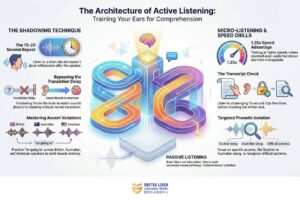
Passive vs. Active Listening
Having English radio playing in the background feels productive. It isn’t. Passive listening,audio you hear while doing other things,doesn’t build the neural pathways needed for exam comprehension. Your brain simply filters it out.
Active engagement requires deliberate focus. You’re not just listening to what is said; you’re analyzing how it’s said. What phonemes changed? Where did connected speech occur? How did intonation signal meaning?
The “Shadowing” Technique
Shadowing is deceptively simple: listen to a short clip (10–20 seconds) and repeat it aloud exactly as spoken,matching speed, intonation, and emotion,milliseconds after the speaker finishes.
Here’s why it works: Shadowing forces your mouth and ears to synchronize. You can’t shadow while translating mentally; your brain is too occupied matching sounds. Over time, this builds direct connections between English sounds and meaning, bypassing the “translation delay” that slows comprehension.
Pro-Tip from the classroom: One phrase that reveals accent variation dramatically is “I’m going to.” British speakers say “I’m going to,” Australians shift it to “I’m gonna,” and some North American speakers flatten it even further to “ah’m-gunna.” When you shadow this phrase across accents, your mouth learns the muscle memory, and your ear learns to anticipate the variation. Mastering this single phrase trains your brain for dozens of other contractions.
Start with easier accents (British news broadcasts) and gradually move to challenging ones (Scottish speakers, fast Australian). Spend 15 minutes daily, and you’ll notice accent adaptation accelerating within two weeks.
Micro-Listening Drills
Targeted drills compress learning. Pick a single 10-second clip featuring an accent that challenges you,Australian slang in a Section 1 conversation, for example. Listen 5–10 times without the transcript, writing down every word you catch. Then check the transcript. This exercise isolates specific phonetic patterns and forces your brain to attend to details passive listening ignores.
Speed variation also works: Use a media player to increase playback speed to 1.25x. After drilling at this speed, the actual exam feels slower and more manageable.
Curating Your Listening Diet: Resources & Routine

Diversifying Your Media Sources
Your listening diet determines what accents your ear recognizes automatically. Diversify intentionally:
- BBC Radio 4 and BBC Radio 4 Extra provide British accents across documentaries and dramas.
- ABC Radio National features Australian accents in news and current affairs.
- NPR and Planet Money offer North American content.
- TED Talks are invaluable for Section 4 practice,they’re structured academic monologues featuring speakers from around the world.
Commit to 20 minutes daily with different sources across the week. Repetition with variety is the formula.
The Singaporean Advantage
If you’re preparing for IELTS in Singapore, you already possess an advantage most non-native speakers lack: daily exposure to multicultural English. Singapore’s English environment includes not only British colonial influence but also Singaporean English, Indian English, Chinese English, and international business English. This multicultural context trains your ear for accent variety organically. Rather than treating accent adaptation as a new skill, you’re refining one you’ve already begun developing. Lean into this strength,it’s why many Singaporean test-takers excel in IELTS Listening compared to their peers from linguistically homogeneous countries.
Structured vs. Unstructured Preparation

Self-study is powerful, but structured feedback accelerates progress. While you can build accent familiarity independently, guided material exposure and human feedback shorten the timeline significantly. Some learners benefit from test centers or coaching environments that curate authentic materials you wouldn’t find browsing YouTube. Whether through online forums or preparation venues, the value lies in being exposed to materials and feedback loops you might otherwise encounter much later.
Once you move beyond beginner-level grammar, authentic materials (real interviews, documentaries, podcasts) outperform scripted ESL tapes every time. Your brain adapts to real language faster than artificial speech.
One such IELTS expert you can count on is United Lisen Education Centre, an IELTS official test venue and designated training provider.
Practical Application: Handling Accents on Test Day

The “Tune-In” Strategy
The 30 seconds before each IELTS section is not dead time. Use it strategically. Read the questions not just to identify answer types (noun, number, date), but to predict context and potential speaker tone.
If a question asks about “university accommodation options,” you know the speaker will be formal and organized. If it asks about “favorite weekend activities,” expect casual, conversational speech with potential digressions. This prediction primes your ear, reducing the cognitive adjustment needed when unfamiliar accents appear.
Identify signpost words,”However,” “Therefore,” “On the other hand,” “In conclusion”,which are pronounced clearly across all accents. These words signal where answers typically appear, and they’re your anchor points during challenging passages.
How to Maintain Momentum and Stay Focused
The single most damaging habit in IELTS Listening is dwelling on a word you didn’t catch while the recording continues. You lose the next three words chasing the one that passed you by.
The “Let It Go” Rule is counterintuitive but essential: if you encounter a word you don’t fully catch, accept it immediately and refocus forward. Spending cognitive energy on the past guarantees you’ll overlook the future.
Use contextual guessing when an accent obscures a specific sound. If you catch “I need to ___ at the station” and the verb isn’t entirely clear, grammar and logic suggest: “pick up,” “drop off,” or “meet.” Listen for phonetic fragments,even a partial sound,and let context narrow the options. On test day, this educated guess beats a blank answer.
Conclusion
Accent adaptation isn’t magic, and it isn’t luck. It’s the product of consistent, targeted exposure to real English spoken by real people from different regions. Consistency over intensity is the governing principle: 20 minutes of active, focused listening daily beats a 4-hour cram session once a week. Your brain consolidates language learning during sleep, and daily exposure ensures continuous progress. This training does more than help you pass IELTS. It prepares you for the actual experience of university lectures, workplace conversations, and everyday life in English-speaking countries, where accent diversity isn’t an exception,it’s the norm.
Your ears will adapt with exposure. Trust the process, follow the techniques, and approach test day knowing you’ve trained not just for the exam, but for real communication.