
Standing at the crossroads of IELTS preparation, countless Singapore students face a critical decision: Should you take IELTS Academic or General Training? This choice affects your test preparation strategy, university admission, career progression, and migration plans.
The wrong decision costs more than just the S$406 (after GST) test fee (check IDP official website for the latest fee). It means wasted months of preparation and delayed applications. This guide helps you make the right choice the first time, ensuring your future starts with IELTS success.
Before determining which IELTS module best aligns with your objectives, it is important to first grasp the key distinctions between IELTS Academic and General Training. In particular, these differences pertain to each module’s official intent and the typical contexts in which they are recognized or required.
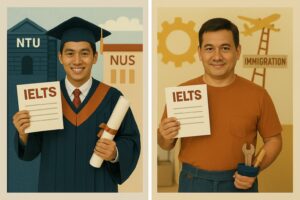
IELTS Academic serves candidates pursuing higher education or professional registration. Universities worldwide, including NUS and NTU in Singapore, require Academic scores for admission. Professional bodies, such as the Singapore Medical Council and the Allied Health Professions Council (AHPC), mandate Academic IELTS for international healthcare professionals.
IELTS General Training targets those seeking migration, secondary education, or work experience in English-speaking countries. The Immigration Departments of various countries accept General Training for certain visa categories, while employers often prefer it for non-technical roles.
Structural Differences IELTS Academic VS General Training: What Actually Changes
| Listening | 40 questions, 30 minutes | Identical format | No preparation difference needed |
| Reading | 3 long, complex passages from academic sources (e.g., journals, research papers) | 3 sections containing 5-6 texts from everyday sources (e.g., notices, advertisements, work manuals) | Academic requires deeper analytical skills; General Training requires broader context switching between varied everyday text types |
| Writing Task 1 | Describe visual data (150 words, 20 minutes) | Write a letter (150 words, 20 minutes) | Completely different skill sets required |
| Writing Task 2 | Argumentative essay (250 words) | Identical essay format | Same preparation works for both |
| Speaking | 11-14 minute interview | Identical format | No difference in preparation |
Academic IELTS is a mandatory requirement for admission to universities in Singapore. For instance, the National University of Singapore (NUS) stipulates a minimum overall band score of 6.5, with certain competitive programs demanding scores as high as 7.5. In contrast, immigration pathways may differ significantly; some destinations accept both Academic and General Training modules, while others require only one. Choosing the incorrect module may render your application ineligible, as exemplified by an applicant who submits a General Training score to a program that mandates the Academic version, resulting in application delays or outright rejection.
Beyond these technical contrasts, many Singapore test-takers struggle with certain real-world challenges when choosing and preparing for their IELTS module.
The persistent myth that General Training offers an easier path creates dangerous misconceptions. Research from Cambridge Assessment English shows General Training reading requires 30/40 correct answers for band 6.0, while Academic needs only 23/40. This stricter marking compensates for supposedly “simpler” texts.
Fear of Selecting the Wrong Module
Test centers report that a significant number of test-takers book the wrong module initially, discovering their error only after registration. This mistake typically occurs when students rely on informal advice rather than checking official requirements.
Consider this scenario: A nursing professional prepared for General Training based on colleague advice, only to discover the Singapore Nursing Board requires Academic IELTS with minimum band 7.0 in each component.
Resource Scarcity for General Training
Singapore bookstores stock predominantly Academic IELTS materials. This disparity forces General Training candidates to rely heavily on online resources or outdated materials. When selecting the best IELTS course in Singapore, ensure that it offers module-specific materials for your chosen path.
Your Decision Framework
Start with Your End Goal
Choose Academic if you’re:
- Applying to universities (degree programs)
- Seeking professional registration (medical, legal, engineering)
- Pursuing postgraduate research
- Applying for academic positions
Choose General Training if you’re:
- Immigrating (check specific country requirements)
- Seeking vocational training
- Applying for work visas
Verify Official Requirements
Never assume—always verify. Check these authoritative sources:
- University admissions pages (not general information)
- Immigration department websites (use .gov domains like IRCC official guidelines)
- Professional body registration guidelines
- Employer HR departments (get written confirmation)
Evaluate Your Strengths Objectively
Academic Strengths Indicators:
- Comfortable interpreting graphs, charts, and data
- Strong academic vocabulary
- Experience with research papers
- Analytical writing experience
General Training Strengths Indicators:
- Natural letter-writing ability
- Strong everyday vocabulary
- Workplace communication experience
- Comfort with varied text types
Strategies for Success in Your Chosen Module
Academic Module Optimization
Foundation Building (Weeks 1-2): Master academic vocabulary, practice interpreting graphs daily, and improve your IELTS reading speed for lengthy academic texts.
Skill Integration (Weeks 3-4): Complete timed Task 1 descriptions, analyze model answers, and review common grammar mistakes to avoid in IELTS writing.
Full Integration (Weeks 5-8): Complete full practice tests bi-weekly, focus on time management, and review errors systematically.
General Training Mastery
Format Familiarization (Weeks 1-2): Study letter formats, read diverse everyday texts, and build practical vocabulary lists.
Applied Practice (Weeks 3-4): Write one letter daily, practice skimming techniques, and complete Section 1-style reading practices.
Performance Enhancement (Weeks 5-8): Take weekly practice tests, focus on accuracy in easier sections, and perfect letter openings and closings.
Real Student Experiences
Case Study 1: James, a Singaporean engineer, initially chose General Training for Canadian immigration. After 6 weeks of preparation, he discovered his engineering credentials required Academic IELTS. The switch cost him 3 months and S$790 in test fees.
Case Study 2: Priya researched thoroughly before choosing Academic for her UK university application. Her focused 3-month preparation helped her achieve high IELTS scores with United Lisen, resulting in band 7.5 overall on her first attempt.
Common Misconceptions Debunked
Myth: “General Training guarantees higher scores”
Reality: Band score requirements adjust for difficulty. General Training’s “easier” texts come with stricter marking criteria.
Myth: “Academic IELTS works everywhere”
Reality: Some immigration programs specifically require General Training and won’t accept Academic scores.
Myth: “You can switch modules after booking.”
Reality: Changes are subject to test center policies and deadlines – typically requiring 14 days’ advance notice with a transfer fee of approximately 25% of the test fee.
Action Plan and Decision Checklist
☐ Check official requirements from your target institution/immigration body
☐ Confirm which module your specific program requires
☐ Assess your strengths in academic vs. everyday English
☐ Locate adequate study materials for your chosen module
☐ Ensure at least 8 weeks for focused preparation
☐ Book a diagnostic test to assess your starting level

Frequently Asked Questions
Q: Can I use my Academic IELTS score for immigration purposes?
A: It depends on the country and visa category. Canada’s Express Entry accepts both modules, while Australia’s skilled migration program has varying requirements by occupation.
Q: Is the Speaking test different between Academic and General Training?
A: No, the Speaking test is identical for both modules—same three parts, same format, same duration.
Q: How much harder is Academic Reading compared to General Training?
A: Academic Reading features three long passages from academic journals and books, requiring analytical skills. General Training includes 3 sections with 5-6 shorter everyday texts. Difficulty is subjective and depends on your background.
Q: Which module do Singapore employers prefer?
A: The majority of non-academic Singapore employers accept either module, focusing more on the overall band score. Positions requiring academic writing skills may prefer Academic IELTS.
Q: Do I need different books for Academic and General Training?
A: Yes, you need module-specific materials for Reading and Writing Task 1. Academic requires books on data interpretation, while General Training needs letter-writing guides.
Conclusion
Choosing between IELTS Academic and General Training isn’t about finding the “easier” option—it’s about aligning your test choice with your goals and strengths. The right module depends on three factors: your destination’s requirements, your linguistic strengths, and your preparation resources.
Start by confirming official requirements, then honestly assess your capabilities. Remember, success comes not from choosing the “easier” module, but from committed preparation for the right one. With proper planning and focused practice, either module becomes manageable.
Take action today: Check your specific requirements, book your test date 8-12 weeks out, and begin module-specific preparation immediately.
Ready to begin your IELTS journey with confidence? Contact United Lisen today for module-specific guidance and expert preparation strategies tailored to your goals.